

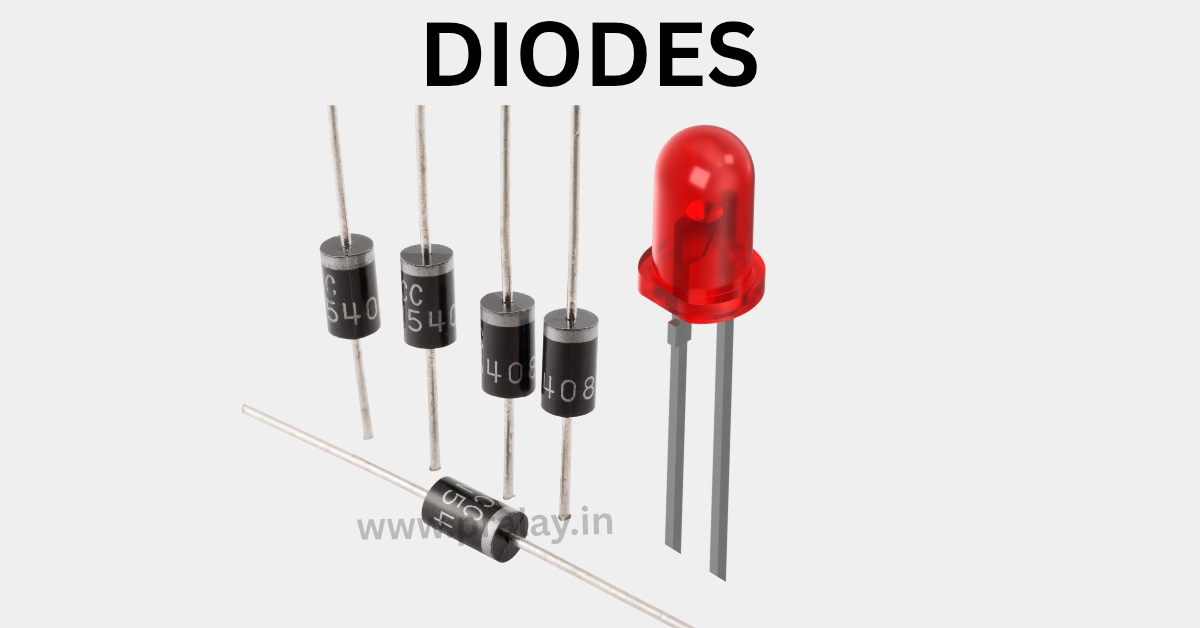
What is a Diode?
A diode is a two-terminal semiconductor device that acts as a one-way switch for electric current. It allows current to flow easily in one direction while blocking it in the opposite direction.
Thanks to this unilateral property, diodes are fundamental in modern electronics. They are widely used for:
- AC to DC rectification
- Overvoltage protection
- Signal demodulation
Diode Symbol and Polarity
A standard PN junction diode has two terminals:
- Anode (+): Connected to the P-type semiconductor
- Cathode (−): Connected to the N-type semiconductor
Circuit Symbol:
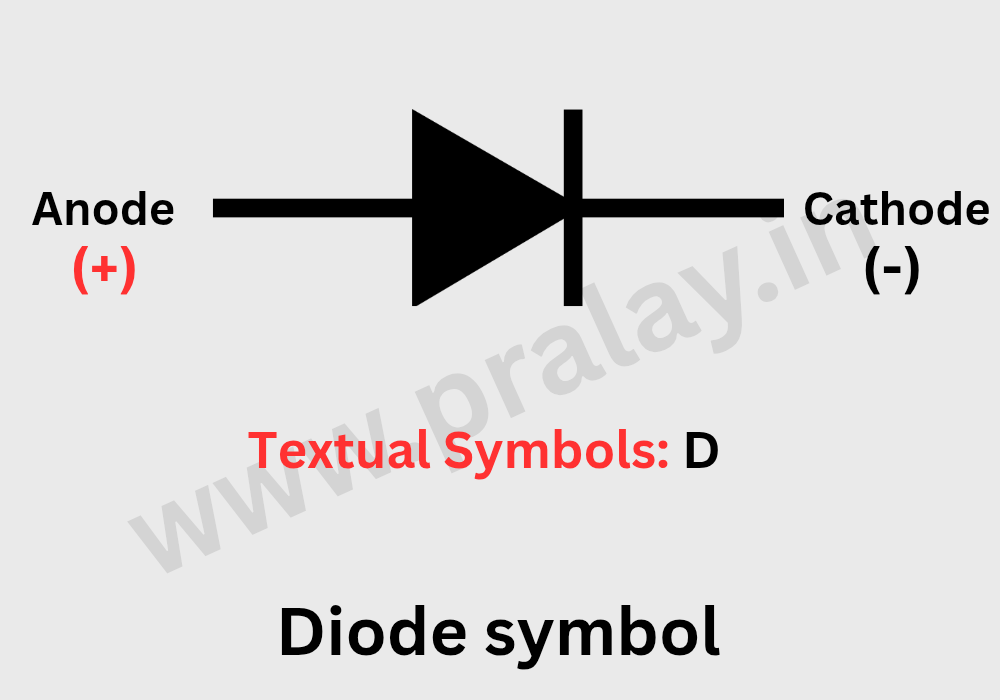
- The triangle shows the allowed direction of conventional current (anode → cathode).
- The vertical line represents the barrier blocking reverse current.
- On physical diodes (e.g., 1N4007), a silver or black stripe marks the cathode.
Diode Working Principle
A diode is formed by joining P-type (holes) and N-type (electrons) semiconductors, creating a PN junction. At the junction, charge carriers recombine, forming a depletion region with an internal barrier potential:
- ~0.7V for Silicon
- ~0.3V for Germanium
1. Forward Bias (Conducting State)
- Connection: Positive terminal → Anode, Negative terminal → Cathode
- Action: External voltage overcomes the barrier potential
- Result: Current flows once voltage > threshold (0.7V for Silicon)
2. Reverse Bias (Blocking State)
- Connection: Positive terminal → Cathode, Negative terminal → Anode
- Action: Depletion region widens, blocking current
- Result: Only negligible leakage current flows
Common Types of Diodes and Their Uses
| Diode Type | Primary Function | Common Applications |
|---|---|---|
| PN Junction Diode | Unidirectional current | Rectifiers, power adapters |
| Zener Diode | Controlled reverse conduction | Voltage regulation, surge protection |
| LED | Converts electricity to light | Indicators, displays, lighting |
| Schottky Diode | Low forward voltage, fast switching | RF circuits, power supplies |
| Photodiode | Converts light to current | Solar panels, optical sensors |
Ideal vs. Real Diode
- Ideal Diode:
- Zero resistance
- Zero forward voltage drop
- No reverse leakage
- Real Diode:
- Requires cut-in voltage (~0.7V for Silicon)
- Has internal resistance
- Can break down if reverse voltage exceeds PIV rating
Types of Diodes and Their Applications
1. PN Junction Diode
- Function: Allows current in one direction only.
- Applications: Rectifiers, power adapters, basic electronic circuits.
2. Zener Diode
- Function: Conducts in reverse once breakdown voltage is reached.
- Applications: Voltage regulation, surge protection.
3. Light Emitting Diode (LED)
- Function: Converts electrical energy into visible light.
- Applications: Indicators, displays, decorative and home lighting.
4. Schottky Diode
- Function: Very low forward voltage drop (~0.2–0.3V) and fast switching.
- Applications: RF circuits, high‑frequency power supplies.
5. Photodiode
- Function: Generates current when exposed to light photons.
- Applications: Solar panels, optical sensors, remote controls.
6. Tunnel Diode
- Function: Exhibits negative resistance due to quantum tunneling.
- Applications: High‑speed switching, microwave oscillators.
7. Varactor Diode (Varicap)
- Function: Acts as a variable capacitor controlled by voltage.
- Applications: RF tuning circuits, voltage‑controlled oscillators.
8. Laser Diode
- Function: Emits coherent laser light.
- Applications: Optical communication, barcode scanners, CD/DVD drives.
9. Avalanche Diode
- Function: Operates in avalanche breakdown region.
- Applications: Protection against high voltage transients.
10. PIN Diode
- Function: Has an intrinsic layer between P and N regions, used for RF switching.
- Applications: Microwave circuits, attenuators, photodetectors.
Quick Comparison Table of Diode
| Diode Type | Key Feature | Common Use Case |
|---|---|---|
| PN Junction | One‑way current flow | Rectifiers, adapters |
| Zener | Reverse breakdown regulation | Voltage stabilizers |
| LED | Emits visible light | Indicators, lighting |
| Schottky | Low voltage drop, fast | RF, switching power supplies |
| Photodiode | Light‑sensitive | Solar cells, sensors |
| Tunnel | Negative resistance | High‑speed oscillators |
| Varactor | Voltage‑controlled capacitance | RF tuning circuits |
| Laser Diode | Coherent laser light | Optical communication |
| Avalanche | High voltage protection | Surge suppression |
| PIN Diode | RF switching | Microwave circuits |
Frequently Asked Questions (FAQ)
Q1: What is the main purpose of a diode?
A diode directs current in one path and prevents reverse current from damaging sensitive components.
Q2: How do you test a diode with a multimeter?
- Set multimeter to Diode Mode.
- Red probe → Anode, Black probe → Cathode → Reading: 0.5V–0.7V (healthy diode).
- Reverse probes → Reading: OL (open loop).
Q3: What happens if a diode is connected backward?
It blocks current. If reverse voltage exceeds its breakdown rating, the diode may fail permanently.
You also read: what is the transistor
Conclusion
A diode is one of the simplest yet most powerful components in electronics. By understanding its symbol, polarity, working principle, and types, you can design circuits that are efficient, safe, and reliable.
Whether it’s rectification, voltage regulation, or light emission, diodes remain indispensable in modern technology.