

In electrical and electronic systems, control is everything. Whether starting a motor, ringing a doorbell, stopping a machine, or resetting a circuit, one of the simplest yet most essential devices used is the push button switch. Despite its small size and simple design, it plays a crucial role in industrial automation, consumer electronics, mechanical systems, and safety circuits.
Push button switches are widely used because they are reliable, easy to operate, inexpensive, and durable. From household appliances to complex control panels in factories, they provide quick and intuitive control. Understanding how push button switches work is fundamental for electrical engineers, electronics students, and mechanical system designers.
What is a Push Button Switch?
A push button switch is a mechanical switch that is activated when a button is pressed. It is used to either make (close) or break (open) an electrical circuit. When pressure is applied, the internal contacts change position, allowing or interrupting the flow of current.
Push button switches are commonly classified into two main electrical states:
- Normally Open (NO)
- Normally Closed (NC)
These switches are found in doorbells, motor starters, control panels, calculators, keyboards, elevators, and emergency stop systems.
Working Principle of Push Button Switch
The working principle is based on mechanical contact movement.
Inside the switch, there are:
- Fixed contacts
- Movable contact (connected to the button mechanism)
- Spring mechanism
- Terminals
When the button is pressed:
- The movable contact shifts position.
- It either connects or disconnects the fixed contacts.
- Current flows or stops accordingly.
- When released, the spring returns the contact to its original position.
This simple electromechanical action allows precise control of circuits.
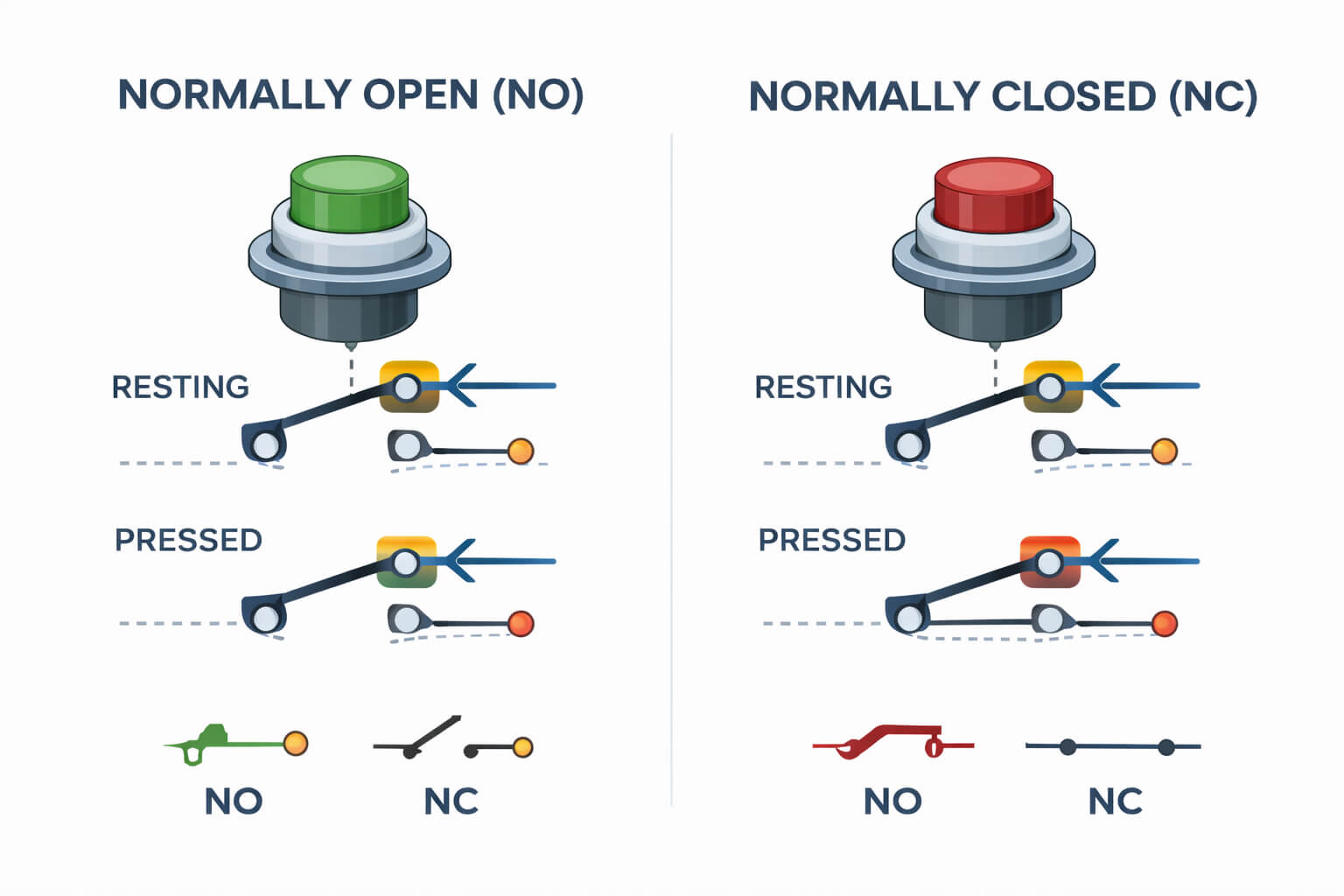
Normally Open (NO) Push Button
A Normally Open (NO) push button means the circuit is open (OFF) in its resting position.
- When pressed → Circuit closes → Current flows.
- When released → Circuit opens → Current stops.
Common example: Doorbell switch.
NO push buttons are used where a device should operate only while the button is pressed.
Normally Closed (NC) Push Button
A Normally Closed (NC) push button means the circuit is closed (ON) in its resting position.
- When pressed → Circuit opens → Current stops.
- When released → Circuit closes → Current resumes.
Common example: Emergency stop switch.
NC push buttons are used in safety systems where stopping a machine instantly is critical.
Comparison Table: NO vs NC Switch
| Parameter | Normally Open (NO) Switch | Normally Closed (NC) Switch |
|---|---|---|
| Default State | Circuit is open (OFF) in resting position | Circuit is closed (ON) in resting position |
| When Button is Pressed | Circuit closes and current flows | Circuit opens and current stops |
| When Button is Released | Circuit opens again | Circuit closes again |
| Current Flow (Normal Condition) | No current flows | Current flows continuously |
| Common Use | Doorbells, start buttons, calculators | Emergency stop buttons, safety circuits |
| Safety Application | Used to activate devices temporarily | Used to stop or disable systems instantly |
| Symbol Representation | Open contact symbol | Closed contact symbol |
| Control Logic | Energizes circuit on press | De-energizes circuit on press |
| Risk in Wire Break | Circuit remains OFF | Circuit becomes OFF (safe failure) |
| Preferred For | Activation control | Safety and protection systems |
| Example Device | Motor start push button | Emergency stop (E-Stop) switch |
| Fail-Safe Capability | Not ideal for fail-safe systems | Ideal for fail-safe applications |
Construction of Push Button Switch
A push button switch consists of several mechanical and electrical components:
Button Cap
The outer part pressed by the user. Often made of plastic or metal.
Return Spring
Ensures the button returns to its normal position after release.
Contact Assembly
Includes stationary and movable contacts made of conductive materials like copper or silver alloy.
Housing
Protects internal components from dust, moisture, and mechanical damage.
Terminals
Provide connection to the external circuit.
Industrial push buttons may include additional features such as LED indicators, waterproof sealing (IP rating), or locking mechanisms.
Types of Push Button Switches
Push button switches come in various forms based on function and application.
Momentary Push Button
Works only while pressed. Returns to original state when released.
Latching Push Button
Remains in its changed state until pressed again. Common in power switches.
Illuminated Push Button
Includes built-in LED for indication.
Mushroom Head Push Button
Used for emergency stop systems.
Metal Push Button
Used in harsh industrial environments.
Each type is selected based on application requirements such as durability, voltage rating, and environmental conditions.
if you looking purchase a push button switch for electrical control panel, check out in Amazon
Applications of Push Button Switch
Push button switches are used across multiple industries and applications.
Industrial Automation
Start/stop motor controls, machine operation panels.
Household Devices
Doorbells, washing machines, microwave ovens.
Automotive Systems
Horn switch, ignition system.
Electronic Circuits
Reset buttons, microcontroller input switches.
Safety Systems
Emergency stop (E-Stop) buttons in factories.
Elevators and Control Panels
Floor selection buttons and operation panels.
Their simplicity makes them essential in both low-voltage electronics and higher-power industrial systems.
Advantages of Push Button Switch
Push button switches offer several benefits:
- Simple and intuitive operation
- Low cost
- Reliable mechanical performance
- Easy installation
- Wide voltage compatibility
- Available in waterproof and dustproof variants
- Suitable for both AC and DC circuits
Because of these advantages, they remain one of the most widely used switching devices.
Limitations of Push Button Switch
Despite their usefulness, they have limitations:
- Mechanical wear over time
- Contact arcing in high-current circuits
- Not suitable for very high-voltage transmission systems
- Limited life cycle compared to solid-state switches
In high-power applications, contactors or relays are often used in combination with push buttons.
Push Button vs Toggle Switch
Push buttons are momentary and used for control signals, whereas toggle switches maintain position and are used for sustained ON/OFF control.
Push buttons are ideal for:
- Temporary control
- Start/Stop operations
- Reset functions
Toggle switches are better for continuous operation.
Importance in Electrical and Mechanical Engineering
For engineers, push button switches are fundamental components in control circuits. They are used in:
- Motor starter circuits
- PLC input systems
- Industrial automation panels
- Control logic systems
Understanding NO and NC push buttons is essential for designing safe and effective electrical control systems.
Conclusion: The push button switch may appear simple, but it is one of the most important control devices in electrical and electronic systems. Whether in household appliances or industrial control panels, it provides reliable and user-friendly operation. Its adaptability, affordability, and ease of use make it indispensable in engineering applications.
For students and professionals, mastering the working and types of push button switches forms a foundation for advanced automation and control system design.