

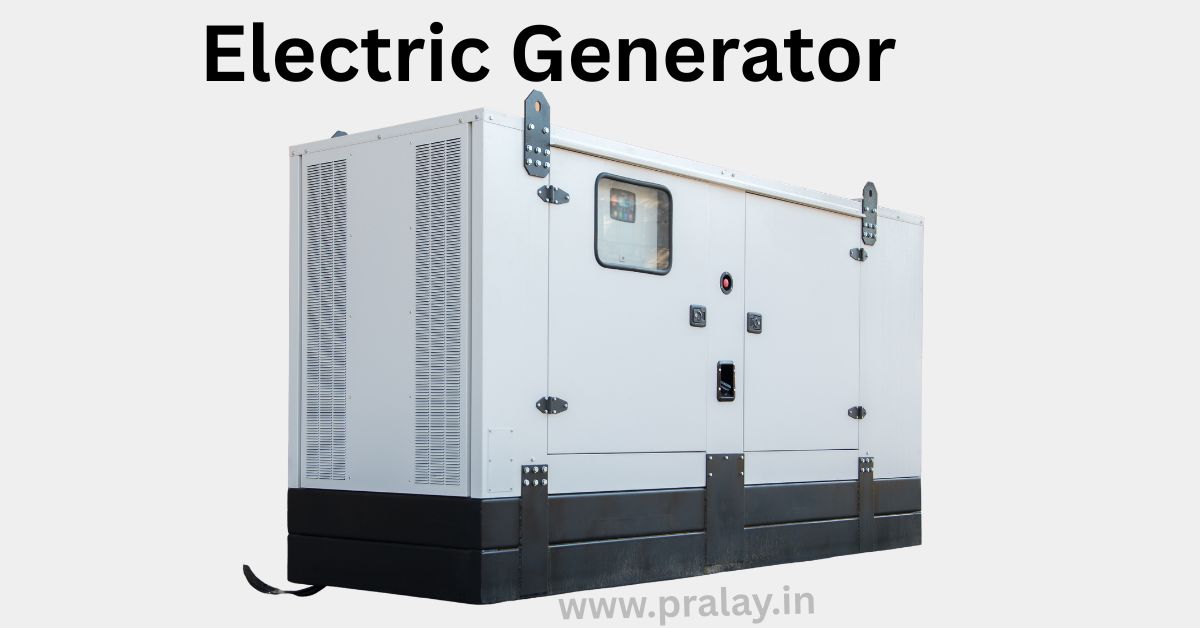
Introduction: Electricity has become the backbone of modern civilization, powering industries, households, hospitals, and transport systems. Behind this constant supply of electrical energy lies one of the most significant inventions in human history the electric generator. An electric generator is an essential device that converts mechanical energy into electrical energy, ensuring an uninterrupted power supply in both small-scale and large-scale applications. From backup systems in homes to massive power stations, generators play a vital role in sustaining daily life and economic activities.
Definition of Electric Generator
An electric generator is a machine that transforms mechanical energy—obtained from sources such as steam turbines, water turbines, internal combustion engines, or wind turbines—into electrical energy. This conversion is based on the principle of electromagnetic induction, discovered by Michael Faraday in 1831. According to Faraday’s law, whenever a conductor moves through a magnetic field, an electromotive force (EMF) is induced, which generates electricity.
Working Principle of Electric Generator
The working of an electric generator is fundamentally based on Faraday’s Law of Electromagnetic Induction.
A conductor (usually copper wire) is mechanically rotated within a magnetic field.
As the conductor cuts across the magnetic lines of force, an EMF is induced.
This induced EMF drives the flow of electrons, thereby producing an electric current.
Electric Generator symbol

Major Components of an electric generator:
Rotor/Armature: The rotating coil where EMF is induced.
Stator: The stationary part that provides the magnetic field.
Prime Mover: A mechanical source (such as a turbine or engine) that provides the necessary rotational motion.
Slip Rings and Brushes: Facilitate the transfer of current in AC generators.
Commutator: Used in DC generators to convert alternating EMF into direct current.
Types of Electric Generators
Electric generators can be broadly categorized into the following types:
1. Based on Current Output
Direct Current (DC) Generators: Produce unidirectional current. Commonly used in battery charging, electroplating, and small power supply applications.
Alternating Current (AC) Generators (Alternators): Produce alternating current, widely used in power stations and modern electrical systems.
2. Based on Energy Source
Hydroelectric Generators: Driven by water turbines in dams.
Thermal Generators: Use steam turbines powered by coal, natural gas, or nuclear energy.
Wind Generators: Powered by wind turbines to generate renewable energy.
Diesel Generators: Use internal combustion engines, widely used for backup power supply.
3. Based on Size and Application
Portable Generators: Small, mobile, and often used for temporary power supply.
Industrial Generators: Large-scale machines capable of supplying electricity to factories, hospitals, and data centers.
Applications of Electric Generators
Power Plants: Primary electricity generation for cities and industries.
Backup Power: Emergency power supply for homes, hospitals, and commercial facilities.
Construction Sites: Temporary energy supply where grid power is unavailable.
Renewable Energy Systems: Harnessing wind, water, and solar power for sustainable electricity.
Frequently Asked Questions (FAQ)
Q1. What is the main purpose of an electric generator?
The main purpose of an electric generator is to convert mechanical energy into electrical energy for powering devices, machinery, and systems.
Q2. Who invented the electric generator?
The principle of the electric generator was discovered by Michael Faraday in 1831, when he demonstrated electromagnetic induction.
Q3. What is the difference between an alternator and a generator?
An alternator produces alternating current (AC), while a DC generator produces direct current (DC). In common usage, “generator” often refers to both types, but alternators are widely used in power stations.
Q4. Which fuel sources can drive a generator?
Generators can be powered by diesel, natural gas, steam (from coal, nuclear, or geothermal energy), wind, water, and even solar in hybrid systems.
Q5. What is the efficiency of an electric generator?
Typical efficiency ranges from 85% to 95%, depending on design, size, and operating conditions.
Q6. Can a generator run continuously?
Yes, but continuous operation requires proper cooling, lubrication, and maintenance. Industrial generators can run 24/7, while portable generators are usually designed for shorter operating periods.
Q7. What is the difference between a generator and a motor?
A generator converts mechanical energy into electrical energy, whereas a motor does the reverse by converting electrical energy into mechanical energy.
Q8. What are some common applications of generators?
Power plants (electricity generation)
Hospitals (emergency backup)
Data centers (uninterrupted supply)
Remote locations (off-grid power)
Construction sites (temporary energy)
Q9. Are generators environmentally friendly?
Traditional fuel-based generators produce emissions, but renewable-energy-driven generators (like wind and hydro) are environmentally friendly and sustainable.
Q10. How do I choose the right generator for my needs?
Consider power requirements (kW/kVA), type of load, fuel availability, portability, runtime, and budget before selecting a generator.
So friends, I’m Pralay Bhunia, I hope I’ve been able to help you with this information about Electric Generator. If you have any more questions or suggestions, please feel free to share them in the comments. Your support always inspires me to share more new information.
External link:
BYJU’S: History of Electric Generators