

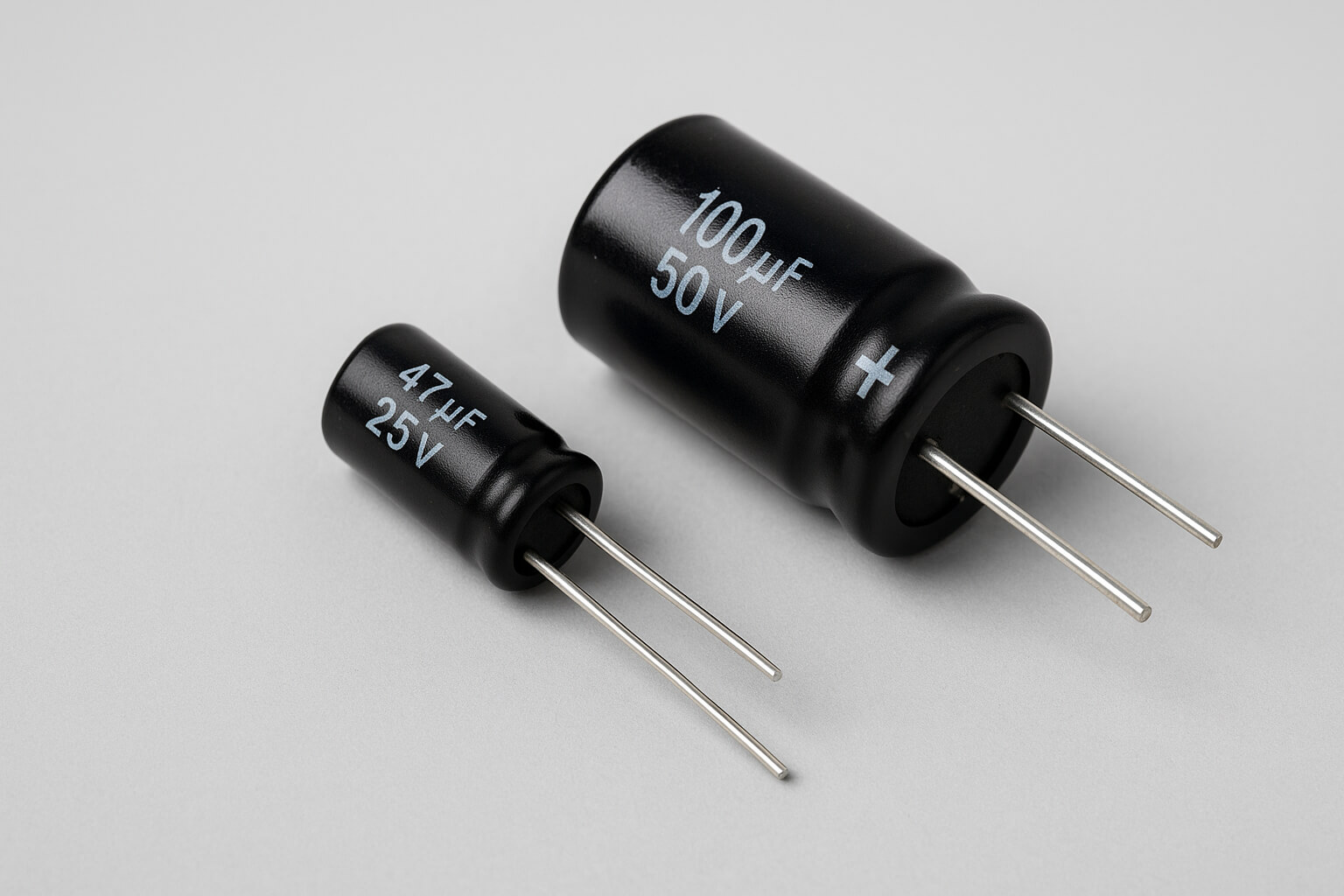
The electrolytic capacitor is one of the most widely used components in electronic circuits, especially in applications that require high capacitance values such as power filtering, signal coupling, smoothing circuits, and energy storage systems. It provides much higher capacitance than ceramic or film capacitors, making it ideal for low-frequency and power electronics. Despite rapid advancements in miniaturized SMD components, electrolytic capacitors continue to be fundamental in power supply units, amplifiers, inverters, and electronic appliances.
Electrolytic capacitors are often recognized by their cylindrical shape and polarity markings. They are sensitive to voltage reversal, temperature, and aging, yet they remain extremely useful when capacitance and compact energy storage are needed. This article explains their construction, working principle, types, advantages, limitations, and practical uses in real-world electronics.
What is an Electrolytic Capacitor?
An electrolytic capacitor is a type of capacitor that uses an electrolyte as one of its electrodes to achieve a very high capacitance value. It is polarized, meaning it has positive and negative terminals and must be connected correctly in a circuit. The dielectric is formed from a thin layer of oxide, allowing high capacitance in a compact volume.
Its capacitance generally ranges from 1µF to thousands of microfarads (µF), often making it the preferred choice for bulk energy storage and filtering in power supplies. However, it is not suitable for high-frequency applications due to its higher Equivalent Series Resistance (ESR) compared to ceramic capacitors.
Working Principle of Electrolytic Capacitor
The working principle is based on electrochemical action and dielectric formation. When voltage is applied, a thin oxide layer forms on the anode (usually aluminum or tantalum). This oxide layer acts as the dielectric. The electrolyte serves as the conductive cathode. Due to the extremely thin dielectric, the capacitance becomes much higher than other capacitor types.
The basic formula used is:
C = εA / d
Where:
• C = Capacitance
• A = Surface area of plates
• d = Thickness of dielectric
• ε = Permittivity of dielectric
The electrolyte aids electrical conduction but must never allow reverse polarity. Incorrect polarity may damage the capacitor or cause it to explode. Therefore, electrolytic capacitors are mainly used in DC circuits.
Construction of Electrolytic Capacitor
A standard electrolytic capacitor consists of aluminum foil coated with an oxide layer, which acts as the dielectric. A second foil (cathode) is soaked in electrolyte and separated by paper material. These layers are tightly rolled and placed inside an aluminum casing. The terminals are connected to the anode and cathode layers and sealed using rubber or plastic end caps for insulation and safety.
The electrolyte is either liquid or solid depending on the capacitor type. In recent years, polymer electrolytic capacitors have gained popularity due to their improved stability, lower ESR, and longer lifespan. The cylindrical construction allows maximum capacitance in a compact form.
Types of Electrolytic Capacitors
Electrolytic capacitors are commonly classified into the following types:
Aluminum Electrolytic Capacitors
These are the most widely used, suitable for high capacitance in power supply circuits. They are affordable but have moderate ESR and aging concerns.
Tantalum Electrolytic Capacitors
These provide better stability, lower leakage current, and longer lifespan. They are smaller but more expensive and sensitive to overvoltage.
Polymer Electrolytic Capacitors
These use conductive polymers instead of traditional liquid electrolyte. They provide low ESR, high ripple current capability, and improved reliability, often used in high-performance digital circuits.
Advantages of Electrolytic Capacitors
Electrolytic capacitors offer very high capacitance-to-volume ratio, making them ideal for power electronics. They are cost-effective, widely available, and easy to mount on PCBs. Their ability to smooth rectified voltage makes them essential in power supplies, audio circuits, motor drivers, and battery chargers. When used correctly within ratings, they operate efficiently and provide long-term stability.
Limitations of Electrolytic Capacitors
Electrolytic capacitors have several drawbacks. They are polarized and can fail if connected in reverse direction. They have higher ESR compared to ceramic capacitors and are not ideal for high-frequency RF circuits. Over time, temperature, ripple current, and aging may degrade performance. They also require proper voltage derating to avoid breakdown.
Despite these limitations, engineers continue to use them extensively due to their high capacitance capabilities.
Applications of Electrolytic Capacitors
Electrolytic capacitors play a crucial role in power electronics. In power supply units (PSUs), they are used for rectification filtering and voltage stabilization. In audio amplifiers, they block DC components while allowing AC signals to pass. In motor drives and inverter circuits, they store energy for short bursts of power. They are also used in LED drivers, voltage regulators, battery chargers, camera flashes, soft-start circuits, and automotive electronic modules.
They remain essential in:
- Low-frequency filtering
- DC coupling and decoupling
- Energy storage
- Timing circuits (with large RC constants)
- Electronic appliances and chargers
Importance in Modern Electronics
With the emergence of switching power supplies, electric vehicles, computing devices, and portable electronics, electrolytic capacitors remain fundamental in both consumer and industrial sectors. Tantalum and polymer capacitors are contributing to size reduction while maintaining high performance. The demand for high-voltage and high-temperature electrolytic capacitors is increasing in power conversion, renewable energy systems and heavy-duty communication infrastructure.
Advances in manufacturing have improved reliability and extended lifespan significantly. With proper derating and thermal management, electrolytic capacitors continue to support critical systems in transportation, automation, and telecommunication industries.
Conclusion
The electrolytic capacitor is an essential component in electronic circuit design. Its ability to provide high capacitance in compact packages makes it valuable for energy storage, filtering, smoothing and amplification. Though it has limitations—especially regarding polarity and frequency response—it remains an indispensable component in power supply engineering and analog electronics.
As technology evolves, polymer and tantalum types are helping electrolytic capacitors stay relevant in high-performance and portable devices. With careful selection and application, they continue to drive the progress of modern electronics.
Electrolytic Capacitor vs Ceramic Capacitor
Electrolytic capacitors are known for providing very high capacitance values in compact packages, typically ranging from microfarads (µF) to thousands of microfarads. They are polarized components and must be installed with correct terminal orientation. Electrolytic capacitors are widely used in power supply filtering, voltage smoothing, audio coupling, and energy storage applications, where larger capacitance is essential for proper circuit operation. However, they have higher leakage current and are not suitable for high-frequency designs due to relatively high ESR (Equivalent Series Resistance).
Ceramic capacitors, on the other hand, offer lower capacitance but deliver excellent performance in high-frequency and digital circuits. They are non-polarized and can be connected in any direction. Due to their low ESR and high stability, ceramic capacitors are commonly used in RF circuits, noise filtering, decoupling power lines, and signal processing. Their compact size allows surface-mount versions (MLCCs) to be used extensively in smartphones, communication devices, and portable electronics.
While electrolytic capacitors excel in energy storage and low-frequency filtering, ceramic capacitors are ideal for high-frequency stability and signal integrity. Both types remain essential in modern electronics, and engineers often use them together in the same circuit for optimized performance.
Comparison Table
| Parameter | Electrolytic Capacitor | Ceramic Capacitor |
|---|---|---|
| Polarity | Polarized (must connect correctly) | Non-polarized (any orientation) |
| Capacitance Range | High (µF to thousands of µF) | Low (pF to µF) |
| Frequency Response | Poor for high frequency | Excellent high-frequency performance |
| ESR (Equivalent Series Resistance) | Higher ESR | Very low ESR |
| Size Availability | Larger sizes | Very small (MLCC) |
| Cost | Moderate to high | Low to moderate |
| Mounting Type | Mostly THT and SMD | Mainly SMD (MLCC) |
| Voltage Rating | Can be high | Generally lower |
| Applications | Power supplies, smoothing, audio circuits | RF circuits, filtering, decoupling |
| Temperature Stability | Moderate | Excellent in Class 1 types |
| Leakage Current | Higher | Very low |
| Longevity | Limited by aging & temperature | Long-lasting |
| Response Time | Slower | Very fast |
| Repairability | Easy to replace | Sometimes difficult |
| Role in Circuit | Energy storage & filtering | Noise reduction & signal conditioning |
Frequently Asked Questions (FAQ)
1. What is an electrolytic capacitor?
It is a polarized capacitor that uses an electrolyte to achieve high capacitance in a compact size.
2. Is an electrolytic capacitor polarized?
Yes, it has positive and negative terminals and must be connected correctly.
3. What are the main uses of electrolytic capacitors?
They are mainly used for power supply filtering, smoothing, energy storage, and audio coupling.
4. What is the typical capacitance range?
Values range from 1µF to several thousand µF.
5. Can electrolytic capacitors be used in AC circuits?
Only in specific circuits with correct design; they are primarily meant for DC use.
6. What happens if polarity is reversed?
It can cause damage, leakage, or even explosion of the capacitor.
7. What materials are used in electrolytic capacitors?
Common materials include aluminum, tantalum, and conductive polymers.
8. What is ESR in electrolytic capacitors?
ESR stands for Equivalent Series Resistance, which affects efficiency and heat generation.
9. Why do electrolytic capacitors fail over time?
Aging, temperature, high ripple current, and overvoltage can degrade the electrolyte.
10. Can electrolytic capacitors be replaced with ceramic capacitors?
Not in high-capacitance applications; they serve different purposes.
11. What is the lifespan of an electrolytic capacitor?
It depends on temperature and usage but typically ranges from 2,000 to 10,000 hours.
12. Are tantalum capacitors better than aluminum capacitors?
They have better stability and lower leakage but are more expensive and sensitive to overvoltage.
13. What is the role of electrolytic capacitors in audio circuits?
They block DC and allow AC signals to pass, improving sound quality.
14. How should electrolytic capacitors be stored?
They should be kept in a dry, cool environment to prevent electrolyte degradation.
15. Are electrolytic capacitors used in modern devices?
Yes, they are widely used in power supplies, chargers, amplifiers, and inverter circuits.
So friends, I’m Pralay Bhunia, I hope I’ve been able to help you with this information about electrolytic capacitors. If you have any more questions or suggestions, please feel free to share them in the comments. Your support always inspires me to share more new information.