

The semiconductor is one of the most influential materials in the modern world, powering everything from smartphones and computers to medical devices and satellites. Without semiconductors, the digital revolution would not have been possible. According to the Semiconductor Industry Association, global semiconductor sales surpassed $580 billion in 2022, reflecting their vital role in technology and economic growth. To understand why semiconductors are so important, it is essential to explore their definition, properties, and diverse applications.
What is a Semiconductor?
A semiconductor is a material whose electrical conductivity lies between that of a conductor, like copper, and an insulator, like glass. Its unique property is that conductivity can be controlled by temperature, light, and impurity addition, making it the backbone of electronic devices. Common semiconductor materials include silicon, germanium, and gallium arsenide.
Examples of Semiconductors
The most widely used semiconductor is silicon, due to its abundance and cost-effectiveness. Germanium and gallium arsenide are also used in specialized applications such as high-speed devices and optoelectronics.
Materials Used in Semiconductors
Silicon dominates the semiconductor industry because of its stability and oxide-forming ability, which is crucial in integrated circuits. Gallium arsenide is preferred for devices requiring faster operation and higher efficiency, such as in satellites and radar systems.
Holes and Electrons in Semiconductors
In semiconductors, the flow of electricity is controlled by two charge carriers: electrons and holes. An electron is a negatively charged particle, while a hole is the absence of an electron that behaves as a positive charge carrier. Together, these carriers determine the current conduction.
Band Theory of Semiconductors
Band theory explains how electrons occupy different energy levels. In semiconductors, the valence band is filled with electrons, while the conduction band is where free electrons can move. The gap between them, called the band gap, is small enough for electrons to jump across when energy is applied, allowing conduction.
Properties of Semiconductors
Semiconductors exhibit distinct properties, such as variable conductivity, sensitivity to temperature, and the ability to respond to light and magnetic fields. These properties make them ideal for designing transistors, diodes, and solar cells.
Semiconductor Chemistry Fundamentals
The study of semiconductors is deeply rooted in chemistry and solid-state physics. To understand how semiconductors function in modern electronics, it is essential to explore their chemical structure, bonding, and the role of electrons and holes. Semiconductor chemistry provides the foundation for innovations such as transistors, diodes, solar cells, and microprocessors.
Atomic Structure and Bonding in Semiconductors

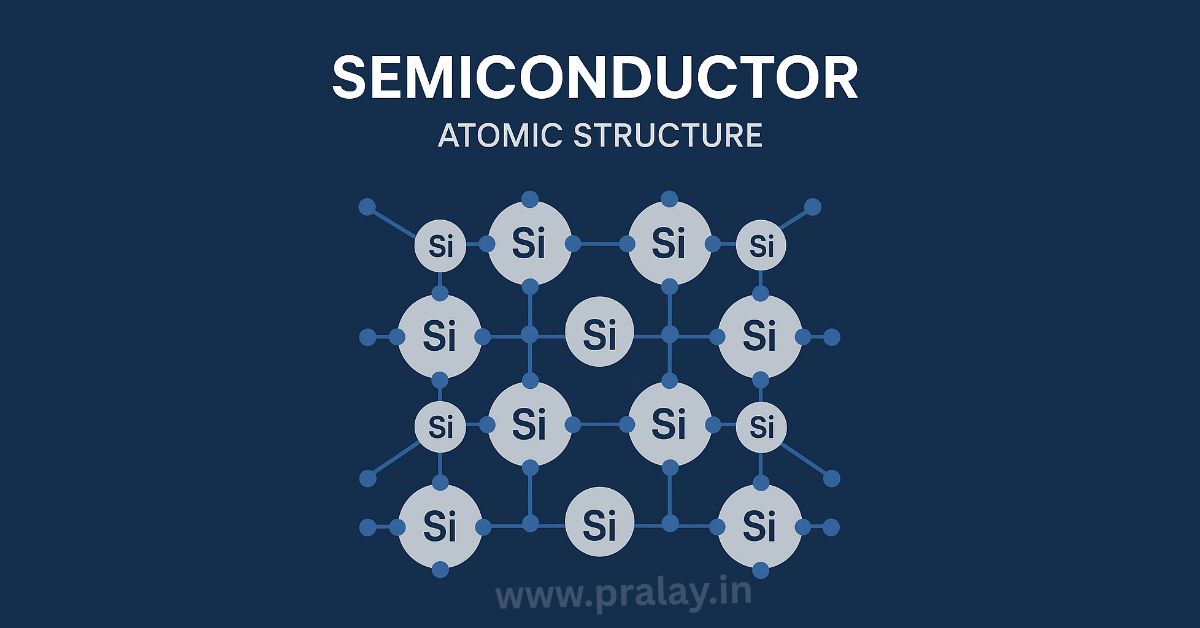
Semiconductors like silicon (Si) and germanium (Ge) belong to Group 14 of the periodic table. Each atom has four valence electrons, allowing them to form covalent bonds with neighboring atoms in a crystal lattice. This stable arrangement creates a crystalline solid with unique electrical properties.
When the temperature rises, some of these covalent bonds break, freeing electrons and creating holes. This dynamic between bound and free electrons is the key to semiconductor conductivity.
Band Gap in Semiconductor Chemistry
A fundamental concept is the band gap (Eg), which is the energy difference between the valence band (where electrons are bound) and the conduction band (where electrons move freely).
- Conductors have overlapping bands (no gap).
- Insulators have a wide band gap (>4 eV).
- Semiconductors have a moderate band gap (usually between 0.5 eV and 3 eV).
For example:
- Silicon has a band gap of 1.1 eV.
- Germanium has a band gap of 0.7 eV.
- Gallium arsenide (GaAs) has a band gap of 1.4 eV.
This moderate band gap allows semiconductors to conduct electricity under specific conditions, making them ideal for controlled electronic devices.
Role of Doping in Semiconductor Chemistry
Doping is a chemical process where small amounts of impurities are introduced into a pure semiconductor (intrinsic). This creates extrinsic semiconductors with enhanced conductivity.
N-type doping: Adding Group 15 elements like phosphorus or arsenic introduces extra electrons.
P-type doping: Adding Group 13 elements like boron or aluminum creates more holes.
Types of Semiconductors
Semiconductors can be classified into two major categories: intrinsic and extrinsic.
Intrinsic Semiconductor
An intrinsic semiconductor is a pure form of material without impurities. Its conductivity depends entirely on temperature and light. Silicon and germanium in pure form are common examples.
Extrinsic Semiconductor
An extrinsic semiconductor is created by doping, meaning the introduction of impurities to improve conductivity.
N-Type Semiconductor
In an N-type semiconductor, impurities from group V elements such as phosphorus or arsenic are added. These provide extra electrons, which serve as majority carriers.
P-Type Semiconductor
In a P-type semiconductor, impurities from group III elements such as boron or aluminum are added. These create holes, which act as majority carriers.
Intrinsic vs Extrinsic Semiconductors
The key difference lies in conductivity. While intrinsic semiconductors rely only on their natural properties, extrinsic semiconductors are engineered for higher and more controlled conductivity, making them suitable for industrial and commercial applications.
Applications of Semiconductors
Semiconductors are the foundation of the electronics industry. They are used in:
- Transistors for signal amplification and switching
- Diodes for rectification
- Integrated circuits for computers and smartphones
- LEDs and solar cells for energy-efficient devices
- Medical equipment and automotive electronics, including sensors and control systems

Semiconductors are also used in:
- Memory chips (RAM and storage): Built on semiconductor materials, they allow tablets to store and retrieve data quickly.
- Display panels (LCD, LED, OLED): Semiconductor-based components control brightness, colors, and touch sensitivity.
- Battery management systems: Semiconductors regulate power usage, extending battery life.
- Wireless connectivity (Wi-Fi, Bluetooth, 5G): Specialized semiconductor chips manage communication between devices and networks
The continuous innovation in semiconductor technology has made it a driving force behind modern advancements such as artificial intelligence, renewable energy, and 5G networks.
Semiconductors are more than just materials; they are the cornerstone of modern civilization. Their ability to control electrical conductivity, coupled with their adaptability through intrinsic and extrinsic modifications, makes them indispensable. From powering personal gadgets to enabling space exploration, semiconductors are truly the invisible engines of progress.
The Role of Semiconductors in Our Lives
Semiconductors in Everyday Technology
Everyday devices like smartphones, tablets, laptops, and televisions are powered by semiconductor chips. These chips consist of billions of tiny transistors that switch electrical signals on and off, enabling everything from messaging apps to video streaming. Without semiconductors, portable and connected devices would not exist.
Role in Communication
Semiconductors enable wireless communication technologies such as Wi-Fi, 5G, and Bluetooth. The small chips in smartphones and tablets make it possible to connect across the globe instantly, making communication faster and more efficient than ever before.
Semiconductors in Healthcare
Modern healthcare relies on semiconductor technology in devices like MRI scanners, pacemakers, digital thermometers, and diagnostic machines. Wearable health trackers, powered by semiconductor sensors, also help individuals monitor vital signs and promote healthier lifestyles.
Impact on Transportation
Automobiles now contain hundreds of semiconductor chips that power systems such as engine control, GPS navigation, airbag deployment, and driver-assistance features. With the rise of electric and autonomous vehicles, semiconductor demand in transportation is expected to increase significantly.
Role in Energy and Environment
Semiconductors play a vital role in renewable energy. Solar cells, made from semiconductor materials like silicon, convert sunlight into electricity. They are also used in wind turbines, power grids, and energy-efficient lighting systems, helping reduce global carbon footprints.
Driving Innovation in Artificial Intelligence
Artificial Intelligence (AI) and machine learning require advanced computing power. Semiconductors designed as graphic processing units (GPUs) and specialized chips provide the speed and efficiency needed to handle complex data, powering innovations in robotics, language processing, and automation.
Semiconductors are not just components of computers; they are the foundation of modern life. They connect us, heal us, transport us, and drive global innovation. As technology continues to evolve, semiconductors will remain at the heart of progress, shaping the way we live, work, and communicate.
Frequently Asked Questions (FAQ)
What is the main use of semiconductors?
Semiconductors are mainly used in electronic devices such as transistors, diodes, solar cells, and integrated circuits. They enable controlled flow of electricity, making them essential for computers, smartphones, and communication systems.
Why is silicon the most used semiconductor?
Silicon is the most widely used semiconductor because it is abundant, inexpensive, and has excellent electrical properties. Its ability to form silicon dioxide makes it ideal for creating integrated circuits and microchips.
What are examples of semiconductor devices?
Common semiconductor devices include diodes, transistors, thyristors, LEDs, and microprocessors. These components form the building blocks of modern electronics.
What is the difference between intrinsic and extrinsic semiconductors?
Intrinsic semiconductors are pure forms of materials like silicon or germanium, where conductivity depends only on temperature. Extrinsic semiconductors are doped with impurities to increase conductivity, leading to N-type or P-type materials.
How do holes and electrons work in semiconductors?
In semiconductors, electrons carry negative charges, while holes act as positive charge carriers. When an electron moves, it leaves behind a hole, and together they facilitate current flow within the material.
What is the band gap in semiconductors?
The band gap is the energy difference between the valence band and the conduction band. A small band gap allows electrons to move easily, enabling controlled conductivity in semiconductor devices.
What are the properties of semiconductors?
Key properties of semiconductors include variable conductivity, response to temperature and light, and the ability to be modified through doping. These properties make them versatile for use in various electronic applications.
What is the future of semiconductor technology?
The future of semiconductors lies in smaller, faster, and more energy-efficient devices, driven by innovations in nanotechnology, quantum computing, and AI hardware. They are also critical in renewable energy and smart infrastructure development.
Author’s comment
So friends, I’m Pralay Bhunia, I hope I’ve been able to help you with this information about semiconductor. If you have any more questions or suggestions, please feel free to share them in the comments. Your support always inspires me to share more new information.