

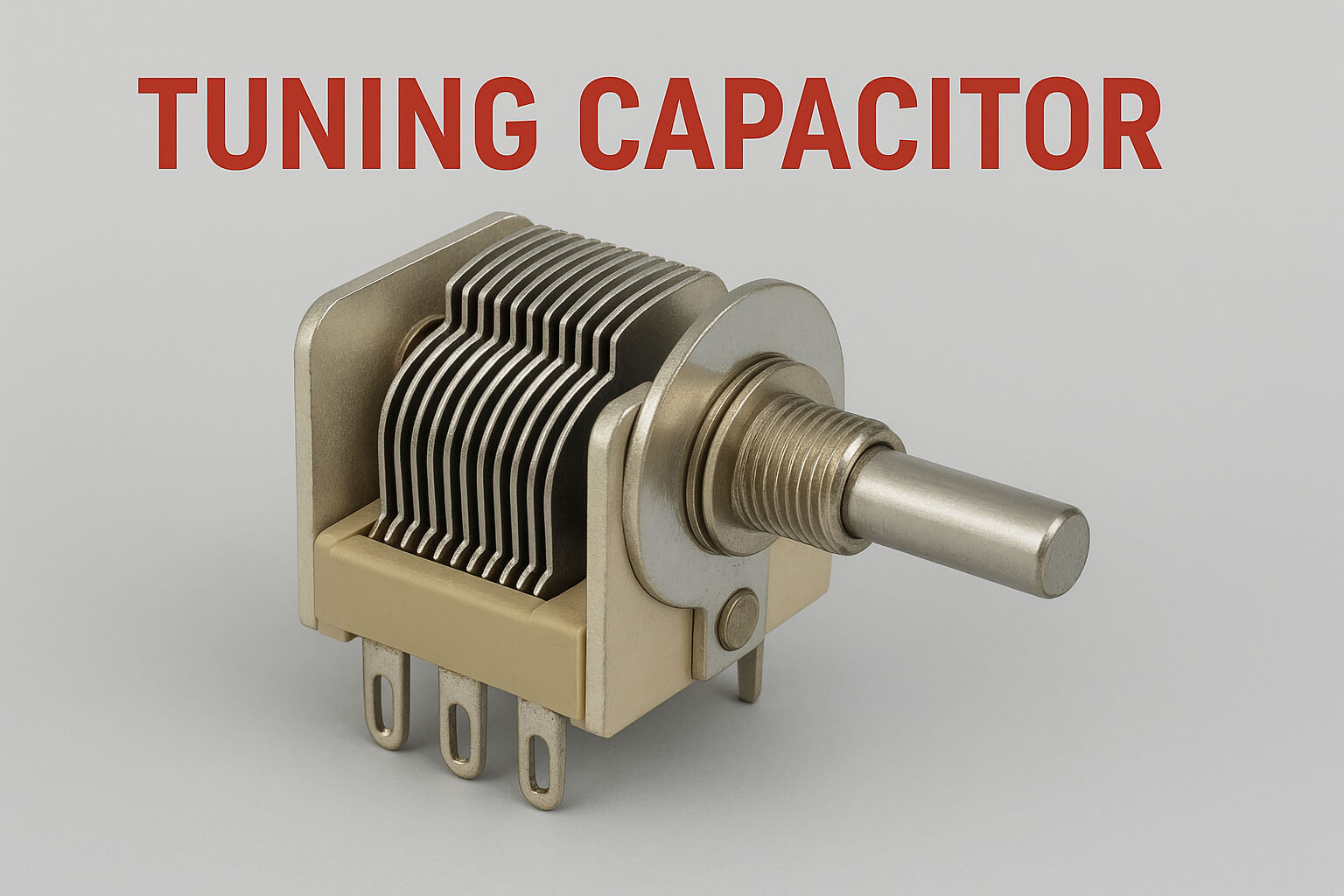
The tuning capacitor, also known as a variable capacitor, is an essential electronic component used to adjust the frequency of resonant circuits. It plays a major role in radio receivers, transmitters, oscillators, RF circuits, and communication systems. Before the era of digital tuning, tuning capacitors were the primary means of adjusting radio stations manually. Even in modern electronics, these capacitors are used to fine-tune frequency, impedance, and phase in high-frequency circuits.
What is a Tuning Capacitor?
A tuning capacitor is a type of variable capacitor used to adjust capacitance manually or electronically. It consists of a rotating plate assembly that varies the distance or overlap area between two conductive plates. This change in geometry modifies the capacitance value and hence the resonant frequency of the connected circuit. These capacitors are commonly used in LC tank circuits, radio tuner circuits, RF amplifiers, and frequency oscillators.
In radio systems, a tuning capacitor allows a user to select specific frequencies while rejecting others. The capacitance range of tuning capacitors typically lies between 10 pF and 500 pF, depending on the design and application.
Working Principle of Tuning Capacitor
The working principle of a tuning capacitor is based on the formula:
C = εA / d
Where:
• C = Capacitance
• A = Overlapping area of plates
• d = Distance between plates
• ε = Permittivity of the dielectric
In a tuning capacitor, the plates are movable. When the rotor is turned, the overlapping area changes, resulting in variable capacitance. This change alters the resonant frequency of an LC circuit. For example, in radio tuning circuits, increasing capacitance lowers the resonant frequency, while decreasing capacitance raises it.
Tuning capacitors may be air dielectric or mica dielectric, depending on their frequency stability requirements. They are often used with inductors to form tuned circuits where frequency selection is essential.
Construction of Tuning Capacitor
A typical tuning capacitor consists of two sets of metal plates: stator plates (fixed) and rotor plates (movable). The rotor is usually connected to a shaft or knob that can be rotated externally. As the rotor turns, the overlap between stator and rotor plates changes, modifying the capacitance. The dielectric medium is generally air or sometimes mica for better frequency stability and lower losses.
The frame supports the plate assembly while maintaining insulation between the plates. High-quality tuning capacitors also include ball bearings for smooth rotation and a metal casing to reduce EMI and maintain structure.
In modern electronics, electronic tuning capacitors such as varactor diodes are used instead of mechanical tuning capacitors for high-speed frequency control.
Types of Tuning Capacitors
Tuning capacitors are available in different types depending on operation and application. Air dielectric tuning capacitors are widely used in radio receivers because of their low losses and high-frequency stability. Mica dielectric tuning capacitors offer better precision and are used in laboratory equipment and scientific instruments.
Trimmer capacitors are small variable capacitors used mainly for calibration purposes. Varactor diodes, also known as tunable electronic capacitors, change capacitance with applied reverse voltage and are used in high-frequency communication circuits, voltage-controlled oscillators (VCOs), and RF filters.
Importance in LC Circuits
One of the most important applications of tuning capacitors is in LC resonant circuits, where an inductor and capacitor combine to form a frequency-selective network. By adjusting capacitance, the frequency can be tuned to match a desired channel or signal. This is why tuning capacitors were essential in analog radio receivers.
When paired with an inductor, a tuning capacitor forms an LC Tank Circuit, which determines the oscillation frequency using the formula:
f = 1 / (2π√LC)
Thus, changing capacitance directly changes the resonant frequency of the circuit.
Applications of Tuning Capacitors
Tuning capacitors are widely used in:
- Radio receivers and transmitters for frequency selection
- Antenna matching circuits in communication equipment
- Oscillators and signal generators
- RF amplifiers and filters
- Antenna tuning for resonance adjustment
- Voltage-controlled oscillators (VCOs)
- Telecommunication systems and radar circuits
- Laboratory instruments and frequency meters
In modern electronics, varactor diodes have replaced mechanical tuning capacitors in most digital applications, but traditional tuning capacitors are still widely used in analog circuits and vintage radio sets.
Advantages of Tuning Capacitors
Tuning capacitors provide mechanical precision and allow real-time control over circuit frequency. They are easy to adjust, offer wide tuning ranges, and maintain reliable performance in RF circuits. Air dielectric versions provide high linearity and low loss, making them ideal for communication equipment. Their simplicity makes them suitable for educational and demonstration circuits as well.
Limitations of Tuning Capacitors
Mechanical tuning capacitors may be bulky and sensitive to vibration or dust. They require physical adjustment and are not suitable for digital control systems. Contact friction may cause slight changes in capacitance over time. Their frequency stability is lower compared to modern varactor-based electronic tuning methods.
However, for analog radio, DIY electronics, antenna matching, and low-cost RF circuits, tuning capacitors remain relevant and reliable.
Future of Tuning Capacitors
The demand for high-speed and digitally controlled tuning has led to increasing use of electronic tuning capacitors, especially varactor diodes and MEMS-based tuning elements. Still, mechanical tuning capacitors are valuable in retro audio systems, amateur radio circuits, antenna matching units, and RF prototyping. In educational labs and experimental setups, they remain a preferred choice for teaching fundamental electronic concepts.
In the future, hybrid tuning techniques combining mechanical precision and electronic control may lead to highly efficient tuning systems for advanced wireless communication, SDR (Software Defined Radio), and antenna-based IoT devices.
Tuning Capacitor vs Variable Inductor – Comparison Table
| Parameter | Tuning Capacitor | Variable Inductor |
|---|---|---|
| Function | Adjusts circuit capacitance | Adjusts circuit inductance |
| Usage | Frequency tuning in radio and RF circuits | Impedance matching and RF filtering |
| Frequency Control | Alters resonance by changing capacitance | Alters resonance by changing inductance |
| Operation Method | Rotating capacitor plates | Adjusting core position or winding turns |
| Typical Range | 10 pF to 500 pF | µH to mH range |
| Polarity | Non-polarized | Non-polarized |
| Physical Movement | Plate rotation or air/mica gap variation | Moving ferromagnetic core or variable coil |
| Applications | RF tuning, oscillators, antenna matching | RF filters, tuners, impedance matching |
| Frequency Stability | Moderate | Generally high |
| Losses | Lower dielectric losses | Slightly higher core losses |
| Response Time | Faster | Slightly slower response |
| Circuit Type | LC circuits, audio and RF circuits | RF tuning circuits and antenna systems |
| Complexity | Mechanically simpler | Mechanically complex |
| Cost | Relatively low | Usually higher |
| Modern Alternative | Varactor diode | Digital tunable RF coil or ferrite core tuner |
Frequently Asked Questions (FAQ)
1. What is a tuning capacitor?
A tuning capacitor is a variable capacitor used to adjust the resonant frequency of circuits, especially in radios and RF systems.
2. How does a tuning capacitor work?
It works by varying the overlap area of its plates, which changes the capacitance and tunes the circuit’s frequency.
3. Where are tuning capacitors used?
They are used in radio receivers, oscillators, RF amplifiers, antenna matching circuits, and frequency filters.
4. What is the typical capacitance range of a tuning capacitor?
It usually ranges from 10 pF to 500 pF.
5. Is a tuning capacitor polarized?
No, tuning capacitors are non-polarized and can be connected in any direction.
6. What is an LC tank circuit?
It is a combination of an inductor and capacitor used to create a frequency-selective resonant circuit.
7. What is the formula for resonance frequency?
f = 1 / (2π√LC), where L is inductance and C is capacitance.
8. What types of dielectric materials are used in tuning capacitors?
Air and mica are commonly used due to their low losses and stability.
9. What is a trimmer capacitor?
It is a small adjustable capacitor used for calibration and fine-tuning in circuits.
10. What is a varactor diode?
A varactor diode is an electronic tuning capacitor whose capacitance changes with applied reverse voltage.
11. Can tuning capacitors be used in digital circuits?
Mechanical tuning capacitors are mainly used in analog circuits; digital systems use varactors or DDS techniques.
12. What causes tuning instability?
Mechanical vibration, dust, humidity, and aging of moving parts may affect accuracy over time.
13. Are tuning capacitors still used today?
Yes, they are still used in RF circuits, antenna tuners, educational labs, and amateur radio equipment.
14. How is capacitance adjusted mechanically?
By rotating the shaft connected to the rotor plates, which increases or decreases their overlap.
15. Why are tuning capacitors important in communication systems?
They allow precise selection of frequencies for signal reception, filtering, and transmission.
So friends, I’m Pralay Bhunia, I hope I’ve been able to help you with this information about Tuning Capacitor. If you have any more questions or suggestions, please feel free to share them in the comments. Your support always inspires me to share more new information.