

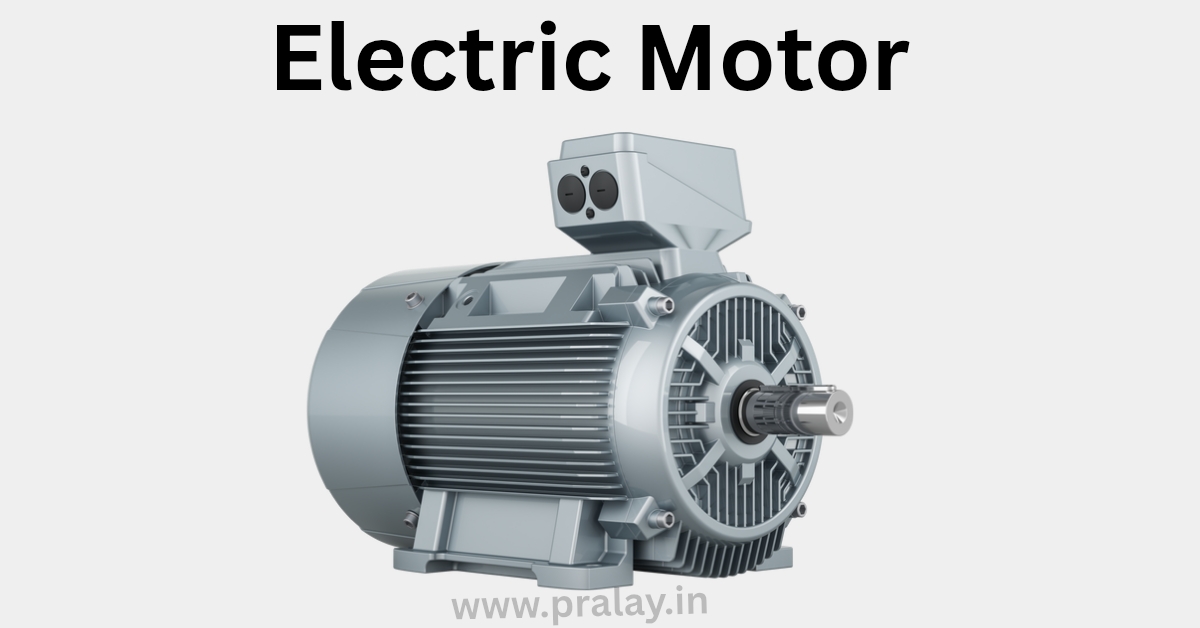
Introduction: Electric motors are fundamental components of modern industry and daily life, powering a vast range of devices from household appliances to industrial machinery and electric vehicles. They play a crucial role in converting electrical energy into mechanical energy, making them indispensable in applications where movement, torque, or mechanical work is required. With the global shift toward electrification and sustainability, electric motors are increasingly central to energy-efficient technologies.
Definition of Electric Motor
An electric motor is an electromechanical device that converts electrical energy into mechanical energy by utilizing the interaction between magnetic fields and current-carrying conductors. This conversion is based on electromagnetic principles, particularly Faraday’s Law of Electromagnetic Induction and Lorentz Force.
Working Principle of Electric Motor
The working principle of an electric motor is grounded in electromagnetism. When an electric current passes through a conductor placed in a magnetic field, it experiences a mechanical force. This is expressed by Fleming’s Left-Hand Rule, which states that if the thumb, forefinger, and middle finger of the left hand are held mutually perpendicular, with the forefinger representing the magnetic field and the middle finger the current, then the thumb points in the direction of motion (force).
In simple terms, the electric current in the motor’s windings creates a magnetic field. This field interacts with the external magnetic field of the stator (or permanent magnets). The interaction produces torque, causing the rotor to rotate.
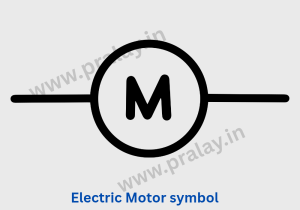
Electric Motor symbol
Major Components of an Electric Motor
1. Stator – The stationary part that generates a magnetic field.
2. Rotor – The rotating part that turns due to electromagnetic forces.
3. Commutator (in DC motors) – Helps reverse the direction of current to maintain unidirectional torque.
4. Windings – Conductors wound into coils to carry current.
5. Bearings & Shaft – Provide support and transmit rotational motion.
Types of Electric Motors
Electric motors can be classified broadly into two categories:
1. Direct Current (DC) Motors
Series DC Motor – High starting torque, commonly used in cranes, hoists, and traction.
Shunt DC Motor – Constant speed, used in fans, blowers, and conveyors.
Compound DC Motor – Combines series and shunt characteristics, suitable for presses and elevators.
2. Alternating Current (AC) Motors
Induction Motor (Asynchronous Motor)
Single-phase Induction Motor: Used in household appliances.
Three-phase Induction Motor: Widely used in industries for pumps, compressors, and conveyors.
Synchronous Motor – Runs at synchronous speed, used in power factor correction and large-scale industrial drives.
3. Special Motors
Stepper Motor – Moves in discrete steps, ideal for robotics and CNC machines.
Servo Motor – Provides precise control of position and speed, used in automation and robotics.
Brushless DC Motor (BLDC) – High efficiency and reliability, commonly used in electric vehicles and drones.
Applications of Electric Motors
Domestic appliances: Fans, refrigerators, washing machines.
Industrial machinery: Pumps, compressors, conveyors, and lathes.
Transportation: Electric vehicles, trains, and ships.
Automation and robotics: Servo and stepper motors for precision control.
Energy sector: Wind turbines and power plants.
FAQ about Electric Motors:
1. What is the main function of an electric motor?
The main function of an electric motor is to convert electrical energy into mechanical energy, which can then be used to perform mechanical work such as rotation, lifting, or driving machines.
2. What are the most common types of electric motors?
The most common types are DC motors, AC induction motors, synchronous motors, stepper motors, servo motors, and brushless DC motors (BLDCs).
3. What is the difference between an AC motor and a DC motor?
AC Motor runs on alternating current, is widely used in industry, and is generally more robust and low-maintenance.
DC Motor runs on direct current, provides high starting torque, and is often used in applications requiring variable speed control.
4. Where are electric motors used in daily life?
Electric motors are found in fans, washing machines, refrigerators, air conditioners, electric vehicles, pumps, elevators, and countless industrial machines.
5. Why are induction motors so widely used?
Induction motors are durable, efficient, low-cost, and require little maintenance, making them the preferred choice in industrial and household applications.
6. What is the working principle of an electric motor in simple words?
When electricity flows through a coil inside a magnetic field, it produces a force that makes the coil (and the attached rotor) rotate, converting electricity into motion.
7. What is the role of a commutator in a DC motor?
The commutator reverses the current direction in the windings to maintain continuous rotation and unidirectional torque.
8. Which motor is used in electric vehicles (EVs)?
Electric vehicles commonly use Brushless DC Motors (BLDCs) or AC induction motors because of their high efficiency, reliability, and precise control.
9. What is the efficiency of electric motors?
Most modern electric motors operate at 85–97% efficiency, depending on design, load, and operating conditions.
10. What is the future of electric motors?
The future points toward smart, energy-efficient, and compact motors, driven by the needs of electric mobility, renewable energy systems, and automation.
So friends, I’m Pralay Bhunia, I hope I’ve been able to help you with this information about Electric Motor. If you have any more questions or suggestions, please feel free to share them in the comments. Your support always inspires me to share more new information.