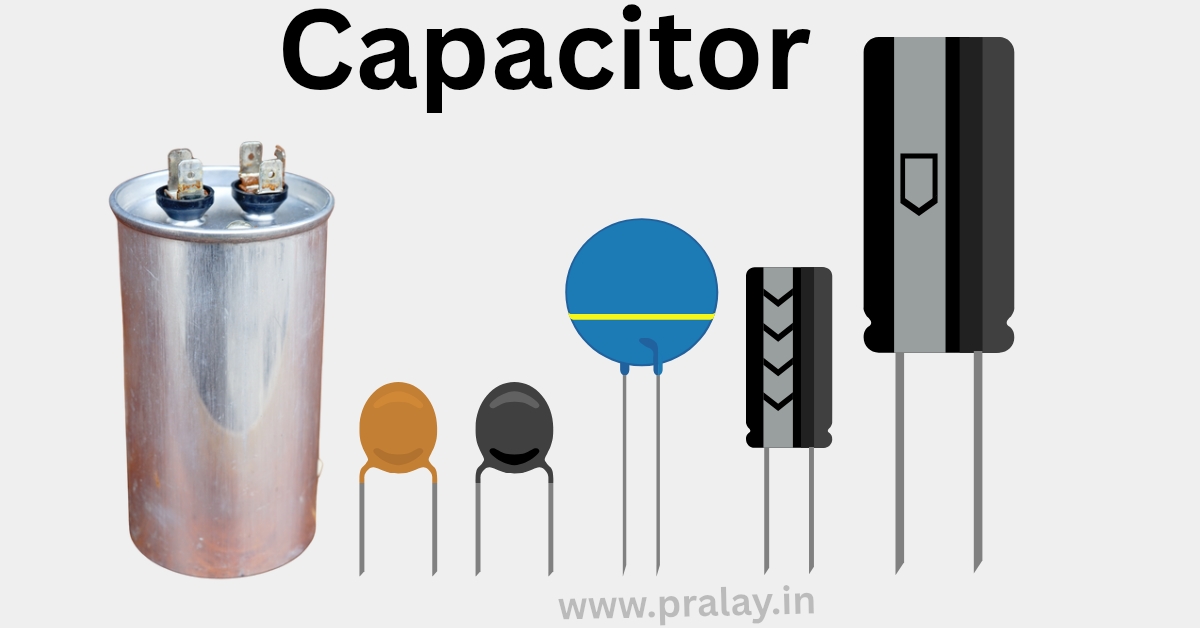
Capacitors are one of the most essential passive components in electrical and electronic circuits. They play a crucial role in storing and releasing energy, filtering signals, stabilizing voltage, and enabling countless applications across industries. Whether you are a student, hobbyist, or professional, understanding capacitors is vital for working with modern technology.
What is a Capacitor?
Definition: A capacitor is an electronic component that stores electrical energy in an electric field. It consists of two conductive plates separated by an insulating material called the dielectric. When a voltage is applied across the plates, an electric charge accumulates, allowing the capacitor to store and release energy when needed.
The ability of a capacitor to store charge is called capacitance, measured in farads (F). Since one farad is very large, practical capacitors are often in microfarads (µF), nanofarads (nF), or picofarads (pF).
Capacitor Symbol
In circuit diagrams, capacitors are represented by standardized symbols:
- Non-polarized Capacitor: Two parallel lines.
- Polarized Capacitor (Electrolytic): One straight line and one curved line, indicating polarity.

Related topics


Types of Capacitors
Capacitors come in various types based on their dielectric material, construction, and usage. Some common types include:
There are two major categories of capacitors, and under them many specific types:
Main Categories
| Category | Description |
|---|---|
| 1. Fixed Capacitors | Have a constant value of capacitance (most common in electronics). |
| 2. Variable Capacitors | Capacitance can be adjusted (used in tuning circuits like radios). |
Types of Fixed Capacitors
These are the most widely used:
| Type | Key Features | Common Uses |
|---|---|---|
| Ceramic | Small, cheap, non-polar | Decoupling, filtering |
| Electrolytic (Aluminum/Tantalum) | High capacitance, polarized | Power supplies, smoothing |
| Film Capacitors | Good stability and low loss | Audio, high-frequency circuits |
| Mica Capacitors | High precision & reliability | RF circuits |
| Paper Capacitors | Older type, rarely used now | High voltage circuits (historically) |
| Polymer Capacitors | Low ESR, long life | High-performance power electronics |
| Supercapacitors | Extremely high capacitance | Energy storage, backup power |
Types of Variable Capacitors
| Type | Description | Use |
|---|---|---|
| Tuning Capacitor | Rotating plates vary capacitance | Radio tuning |
| Trimmer Capacitor | Small adjustable capacitor | Fine calibration |
Capacitor Color Code
Some capacitors (especially older ceramic disc types) use color codes to represent values. The code works like resistor color bands.
| Color | Digit | Multiplier (pF) | Tolerance |
|---|---|---|---|
| Black | 0 | ×1 | – |
| Brown | 1 | ×10 | ±1% |
| Red | 2 | ×100 | ±2% |
| Orange | 3 | ×1,000 | – |
| Yellow | 4 | ×10,000 | – |
| Green | 5 | ×100,000 | ±0.5% |
| Blue | 6 | ×1,000,000 | ±0.25% |
| Violet | 7 | ×10,000,000 | ±0.1% |
| Gray | 8 | ×100,000,000 | ±0.05% |
| White | 9 | ×1,000,000,000 | – |
| Gold | – | ×0.1 | ±5% |
| Silver | – | ×0.01 | ±10% |
| None | – | – | ±20% |
Example:
- Brown (1), Black (0), Orange (×1000 pF) → 10,000 pF = 0.01 µF
Modern capacitors usually have their values printed directly instead of using color codes.
Capacitor in Circuit
Capacitors can be connected in two main ways:
1. Series Connection
- Total capacitance decreases.
- Formula: \( \frac{1}{C_{total}} = \frac{1}{C_1} + \frac{1}{C_2} + \frac{1}{C_3} + \cdots \)
2. Parallel Connection
- Total capacitance increases.
- Formula: \( C_{total} = C_1 + C_2 + C_3 + \cdots \)
Applications of Capacitors
Capacitors are widely used in electronics and electrical engineering. Some key applications include:
- Energy Storage – Store and release energy in power supplies.
- Filtering – Remove unwanted frequencies in power lines or signals.
- Coupling & Decoupling – Pass AC signals while blocking DC, or stabilize voltage.
- Timing Circuits – Used with resistors to create delays (RC circuits).
- Signal Processing – Audio systems, radio tuning, oscillators.
- Motor Starters – Provide phase shift for induction motors.
- Power Factor Correction – Improve efficiency in electrical distribution.
- Supercapacitors in Renewable Energy – Store energy for solar, wind, and backup systems.
Frequently Asked Questions (FAQ) about Capacitors
Q1. What is the main function of a capacitor?
A capacitor stores electrical energy in an electric field and releases it when needed. It is mainly used for energy storage, filtering, and signal coupling/decoupling.
Q2. What is the unit of capacitance?
The unit of capacitance is the farad (F). In practical use, capacitors are usually measured in microfarads (µF), nanofarads (nF), or picofarads (pF).
Q3. How do you identify capacitor polarity?
- Electrolytic capacitors are polarized. The negative lead is usually marked with a stripe.
- Non-polarized capacitors (like ceramic or film) can be connected in any direction.
Q4. What happens if a capacitor is connected with wrong polarity?
In polarized capacitors (like electrolytic or tantalum), reversing polarity can cause leakage, overheating, or even an explosion.
Q5. What is the difference between series and parallel connection of capacitors?
- In series, total capacitance decreases.
- In parallel, total capacitance increases.
Q6. Where are capacitors commonly used?
Capacitors are used in power supplies, filters, motor starters, radios, audio systems, renewable energy storage, and timing circuits.
Q7. What is a supercapacitor?
A supercapacitor (or ultracapacitor) is a type of capacitor that stores a much larger amount of energy compared to regular capacitors. It is often used in backup power, electric vehicles, and renewable energy systems.
So friends, I’m Pralay Bhunia, I hope I’ve been able to help you with this information about Resistor. If you have any more questions or suggestions, please feel free to share them in the comments. Your support always inspires me to share more new information.
Externall links:
- Virtual Labs IIT Kharagpur: Familiarisation with Capacitor