The carbon composition resistor is one of the earliest and most widely recognized components in the history of electronics. Despite the emergence of modern resistor technologies, it remains significant in specific applications due to its unique electrical properties, high energy absorption capability, and robustness in high-pulse circuits. Understanding how carbon composition resistors work, how they are constructed, and where they are used helps engineers and students make informed decisions in circuit design. This article explains the fundamentals, specifications, color coding, advantages, disadvantages, and applications of carbon composition resistors in detail.
What is a carbon composite resistor?
Definition: A carbon composition resistor is a fixed-value resistor made from a mixture of carbon particles and a binding material. This mixture forms a resistive element whose opposition to current flow determines the resistor’s resistance value. Unlike film resistors that rely on thin layers of resistive material, carbon composition resistors use a solid, homogeneous resistive structure. This characteristic gives them an advantage in handling high-energy pulses, making them suitable for surge protection circuits and applications demanding strong transient response.
Construction
The internal construction of a carbon composition resistor is relatively simple yet highly effective. The resistive element is formed by combining finely ground carbon powder with a ceramic binder. The proportion of carbon to binder determines the final resistance value—higher carbon content results in lower resistance and vice versa. After mixing, the material is pressed into cylindrical shapes and baked at high temperatures to harden the structure.
Metallic end caps are attached to both sides of the cylinder to ensure proper electrical connection. Copper or tinned leads are then welded to these caps, enabling easy insertion into circuits. Finally, the resistor body is coated with an insulating material, often epoxy resin, to protect it from moisture, dust, and mechanical wear. The exterior surface is typically printed with color bands that indicate the resistance value and tolerance.
The solid composition of the resistive element differentiates carbon composition resistors from carbon film or metal film resistors. This solid mass allows them to withstand large current surges without breaking down, although it also leads to less stability over time.
Related topics
Specifications
Carbon composition resistors are characterized by several technical specifications that determine their suitability for various circuits. Typical resistance values range from 1 ohm to several megaohms, although the most common values fall between 10 ohms and 2 megaohms. Their tolerance levels are generally wider compared with modern resistor technologies. Standard tolerance values are ±5%, ±10%, and ±20%. Higher precision categories are uncommon due to material limitations.
The power rating of carbon composition resistors usually falls between 0.25 W and 2 W. Their ability to tolerate short, high-energy pulses makes them valuable in surge-resistant applications. However, they exhibit significant temperature coefficients, often ranging from +500 to +1500 ppm/°C, which can result in noticeable resistance changes with temperature variations.
Another important specification is noise level. Due to their granular structure, carbon composition resistors generate more electrical noise than film-type resistors. For this reason, they are not preferred in audio or precision measurement circuits.
Why Carbon Is Used?
Carbon is chosen as the primary resistive element due to its unique electrical and physical properties. Carbon has a natural resistivity that can be controlled by adjusting its concentration and particle size. When mixed with a binder, it forms a durable and cohesive structure that can withstand substantial electrical loads.
The high melting point of carbon allows carbon composition resistors to handle extreme temperatures and short bursts of high current without degrading. Historically, carbon was readily available and inexpensive, making these resistors cost-effective for mass production. Even today, carbon’s ability to absorb and dissipate energy quickly remains unmatched by most modern resistor types.
Additionally, carbon’s non-metallic nature ensures resistance stability under high-frequency conditions, although this advantage is sometimes offset by the resistor’s inherent noise characteristics.
Color Coding
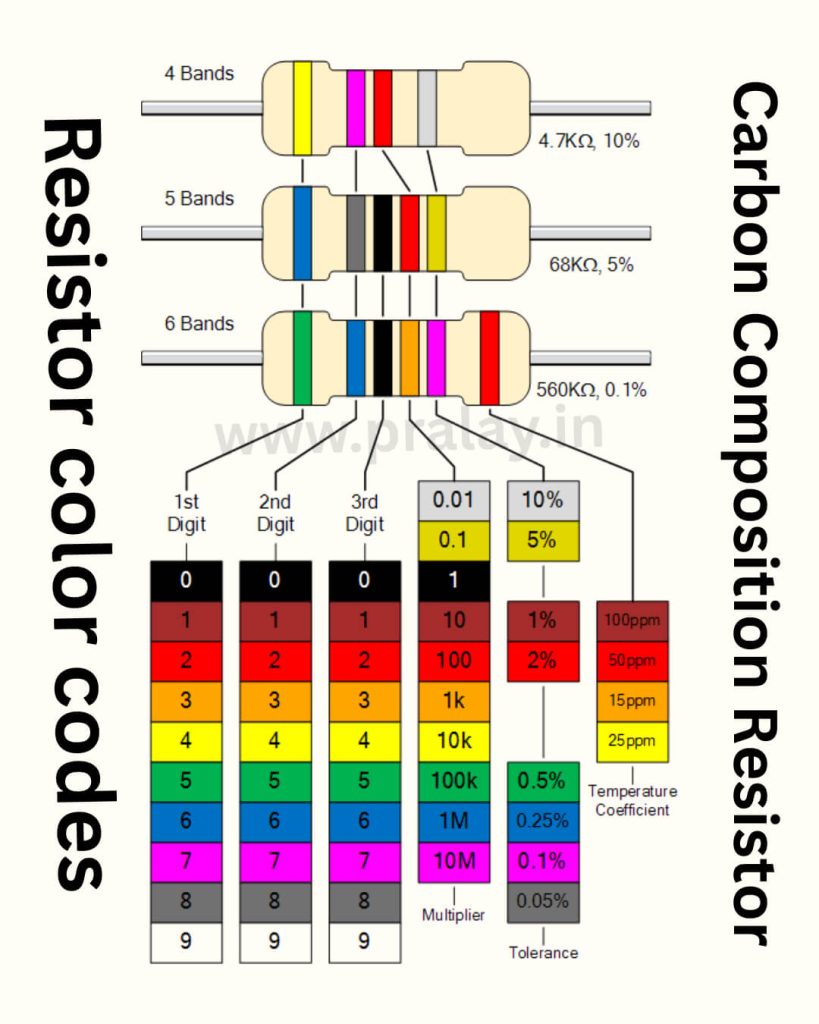
Carbon composition resistors commonly use a standardized color band system to indicate resistance value, tolerance, and sometimes reliability. These bands are essential for quick identification without the need for measurement tools.
General Type Color Coding
General-purpose carbon composition resistors typically use a four-band system. The first and second bands represent the first two significant digits of the resistance value. The third band indicates the multiplier, while the fourth band specifies the tolerance. This system is widely used in consumer and commercial electronics.
Precision Type Color Coding
In certain cases, carbon composition resistors may follow a five-band system, though this is more common in film-type resistors. In the five-band format, the first three bands represent significant digits, the fourth is the multiplier, and the fifth is the tolerance. Precision color coding is less prevalent in carbon composition resistors due to their inherently broader tolerance levels.
Induction Type Color Coding
In specialized induction-type resistors or those used in high-voltage applications, additional color bands may signify reliability ratings or temperature coefficients. These classifications help engineers select resistors suitable for high-frequency or high-energy circuits. The temperature coefficient band commonly appears in military-grade components where precision and environmental stability are required.
Here is a clear and technical explanation of resistor color code calculation formulas along with 4-band, 5-band, and 6-band calculation examples.
Resistor Color Code Calculation
The resistor color code is a standardized method to represent the value, tolerance, and temperature coefficient of a resistor using colored bands.
The general formula for calculating resistance from color bands is:
General Formula
Resistance (Ω) = (Significant Digits) × Multiplier
Tolerance and temperature coefficient do not affect the calculated value, only its accuracy and stability.
Color Digit Table
| Color | Digit | Multiplier | Tolerance | Temp. Coefficient (ppm/°C) |
|---|---|---|---|---|
| Black | 0 | ×10⁰ | — | 250 |
| Brown | 1 | ×10¹ | ±1% | 100 |
| Red | 2 | ×10² | ±2% | 50 |
| Orange | 3 | ×10³ | — | 15 |
| Yellow | 4 | ×10⁴ | — | 25 |
| Green | 5 | ×10⁵ | ±0.5% | — |
| Blue | 6 | ×10⁶ | ±0.25% | 10 |
| Violet | 7 | ×10⁷ | ±0.1% | 5 |
| Gray | 8 | ×10⁸ | ±0.05% | 1 |
| White | 9 | ×10⁹ | — | — |
| Gold | — | ×10⁻¹ | ±5% | — |
| Silver | — | ×10⁻² | ±10% | — |
| None | — | — | ±20% | — |
4-Band Resistor Color Code Calculation
Structure
1st Band = 1st digit
2nd Band = 2nd digit
3rd Band = Multiplier
4th Band = Tolerance
Example (4-Band):
Colors: Red, Violet, Yellow, Gold
- First digit (Red) = 2
- Second digit (Violet) = 7
- Multiplier (Yellow) = ×10⁴
- Tolerance (Gold) = ±5%
Calculation
Resistance = 27 × 10⁴ Ω
= 270,000 Ω
= 270 kΩ ±5%
5-Band Resistor Color Code Calculation
Structure
1st Band = 1st digit
2nd Band = 2nd digit
3rd Band = 3rd digit
4th Band = Multiplier
5th Band = Tolerance
Example (5-Band):
Colors: Brown, Black, Black, Red, Brown
- First digit (Brown) = 1
- Second digit (Black) = 0
- Third digit (Black) = 0
- Multiplier (Red) = ×10²
- Tolerance (Brown) = ±1%
Calculation
Resistance = 100 × 10² Ω
= 10,000 Ω
= 10 kΩ ±1%
6-Band Resistor Color Code Calculation
Structure
1st Band = 1st digit
2nd Band = 2nd digit
3rd Band = 3rd digit
4th Band = Multiplier
5th Band = Tolerance
6th Band = Temperature coefficient (ppm/°C)
Example (6-Band):
Colors: Yellow, Violet, Red, Brown, Red, Brown
- First digit (Yellow) = 4
- Second digit (Violet) = 7
- Third digit (Red) = 2
- Multiplier (Brown) = ×10¹
- Tolerance (Red) = ±2%
- Temp. coefficient (Brown) = 100 ppm/°C
Calculation
Resistance = 472 × 10¹ Ω
= 4720 Ω
= 4.72 kΩ ±2%, 100 ppm/°C
Summary
- 4-band = two digits + multiplier + tolerance
- 5-band = three digits + multiplier + tolerance
- 6-band = three digits + multiplier + tolerance + temperature coefficient
Advantages and Disadvantages
Carbon composition resistors offer several advantages, although they also have limitations that restrict their use in modern electronics.
Advantages
One of the most significant advantages is their ability to withstand high peak currents and voltage pulses. This makes them ideal for protection circuits, power supplies, and applications involving surge currents. Another advantage is their rugged construction. The solid resistive element does not rely on thin films or wire windings, so it is less likely to fail under extreme thermal or electrical stress.
Carbon composition resistors also possess good high-frequency performance because they lack the inductance found in wirewound resistors. Their non-metallic construction allows for minimal inductive reactance, making them effective in RF circuits requiring non-inductive design.
Disadvantages
Despite their strengths, carbon composition resistors have several drawbacks that have led to their decline in mainstream electronics. They exhibit high noise levels due to the irregular structure of carbon granules. Their resistance value tends to drift over time, especially under humid conditions or high temperatures. This instability can lead to inaccurate or unreliable circuit behavior.
Furthermore, carbon composition resistors typically have lower precision and wider tolerance levels than film resistors. Their higher cost relative to performance has also contributed to their replacement by more stable and efficient resistor types.
Applications
Carbon composition resistors continue to be used in applications that demand high-pulse energy handling, durability, and non-inductive properties. They are common in power supply circuits, surge protectors, snubber networks, and high-voltage circuits. Their robust nature makes them suitable for welding machines, motor drives, and lightning arrestors where sudden voltage spikes are common.
In radio frequency applications, carbon composition resistors are sometimes preferred due to their negligible inductance. They are also used in vintage audio equipment, restoration projects, and classic radios where maintaining original component types is essential.
FAQ (frequently asked the questions)
What is a carbon composition resistor?
A carbon composition resistor is a fixed resistor made from carbon powder mixed with a binder, known for its ability to withstand high-energy pulses.
Why are carbon composition resistors used today?
They are still used in surge protection, high-voltage circuits, and vintage electronics due to their strong pulse-handling capability and non-inductive behavior.
How is the value of a carbon resistor identified?
Its value is identified using a color-band code printed on the resistor body, indicating resistance and tolerance.
Are carbon composition resistors stable?
They are less stable than modern film resistors and tend to experience resistance drift over time, especially under heat and humidity.
What are the main advantages of carbon composition resistors?
They can handle high surge currents, offer rugged construction, and exhibit low inductance suitable for RF applications.
What are the disadvantages of carbon composition resistors?
They generate more noise, have wider tolerance levels, and are sensitive to environmental conditions compared to film resistors.
Where are carbon composition resistors used?
They are used in power supplies, surge limiters, pulse circuits, RF equipment, welding machines, and restoration of vintage electronics.
So friends, I’m Pralay Bhunia, I hope I’ve been able to help you with this information about carbon composition Resistor. If you have any more questions or suggestions, please feel free to share them in the comments. Your support always inspires me to share more new information.
External link:
- Resistor Color Codes: What Do the Color Bands Mean? (www.te.com)
- How To Read Resistor Color Codes (www.arrow.com)