DC motors have played a fundamental role in the development of electrical engineering, automation, and industrial machinery. Although modern AC and brushless motors are widely used today, DC motors remain crucial in applications where controllability, precision, and variable speed are required. Their simple construction, reliable performance, and predictable torque characteristics make them suitable for robotics, electric vehicles, conveyors, home appliances, and military equipment.
The evolution of DC machines traces back to the early discoveries of Michael Faraday and the practical design improvements introduced in the 19th century. Today’s DC motors come in various forms, each engineered for specific load characteristics and performance requirements. This article explains the working principle of DC motors, the major types of DC motors, their characteristics, and the applications where each type is preferred.
Definition of a DC Motor
A DC motor is an electromechanical device that converts direct current electrical energy into mechanical rotational motion. The principle behind its operation is based on the interaction between magnetic fields and electric current. When current flows through a conductor placed in a magnetic field, a mechanical force is produced on the conductor. This force, known as the Lorentz force, drives the rotation of the motor’s rotor.
DC motors consist of essential components including the armature, commutator, brushes, field windings or permanent magnets, and a rotating shaft. Their ability to provide smooth control over speed and torque makes them ideal for applications requiring accuracy and variable-speed operation.
Working Principle of a DC Motor
The working principle of a DC motor is based on the fundamental law of electromagnetism, commonly called Fleming’s Left-Hand Rule. When a current-carrying conductor is placed in a magnetic field, it experiences a mechanical force perpendicular to both the direction of current and the magnetic field.
Related topics



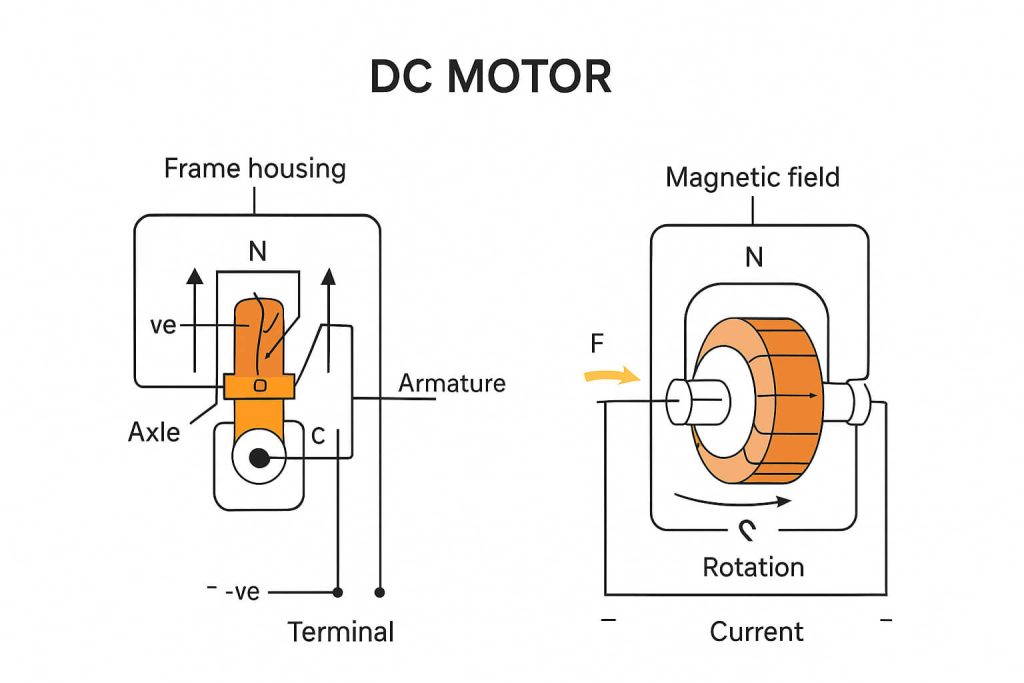
In a DC motor, the armature coil is supplied with direct current. This coil is placed inside a magnetic field created either by permanent magnets or field windings. As current flows through the armature, interaction between the magnetic field and current produces a rotational force on the armature. The commutator reverses the direction of current in the coil at appropriate intervals, ensuring continuous rotation.
This simple but powerful principle forms the basis of all types of DC motors, whether series, shunt, or compound.
Types of DC Motors
DC motors are classified based on how the field windings are connected to the armature. The nature of this connection determines the motor’s speed-torque characteristics, making each type suitable for specific applications.
Below are the major types of DC motors explained in a detailed, paragraph-based format.
DC Series Motor
A DC series motor has its field winding connected in series with the armature. This design ensures that the same current flows through both the armature and the field winding. As a result, the field strength increases with armature current, producing a very high starting torque. This characteristic makes DC series motors ideal for applications requiring heavy initial load movement.
However, the speed of a series motor varies significantly with load. It can run dangerously fast at no load because the current and magnetic field decrease, reducing the opposing magnetic force. Therefore, DC series motors are always used with mechanical loads connected to the shaft to ensure safe operation.
DC Shunt Motor
A DC shunt motor has its field winding connected in parallel (shunt) with the armature. This configuration ensures that the field winding receives a constant voltage independent of the armature current. As a result, the motor produces a stable speed, making it suitable for applications that require consistent operation even under varying load conditions.
DC shunt motors provide moderate starting torque and excellent speed regulation. They are widely used in fans, blowers, small machine tools, and laboratory equipment.
DC Compound Motor
A DC compound motor combines the characteristics of both series and shunt motors. It has two field windings: one connected in series with the armature and the other connected in parallel. This dual-winding structure allows compound motors to produce high starting torque while maintaining good speed regulation.
There are two major types of compound motors: cumulative compound and differential compound. Cumulative compound motors enhance torque characteristics through combined magnetic fields, whereas differential compound motors stabilize torque by opposing fields. Compound motors are preferred in applications such as elevators, rolling mills, and large compressors.
Permanent Magnet DC Motor
A permanent magnet DC motor uses permanent magnets instead of field windings to create the magnetic field. This eliminates the need for field current, making the motor more efficient, compact, and easy to control. Permanent magnet DC motors deliver good torque at low speeds and are commonly used in small electronic devices, robotics, medical equipment, and battery-powered systems.
Their simple construction and low maintenance requirements make them highly reliable for portable and consumer electronics.
Brushed vs Brushless DC Motors
A brushed DC motor uses brushes and a commutator to supply current to the armature. These motors are simple and inexpensive but require periodic maintenance due to wear of brushes. Brushless DC motors, on the other hand, use electronic controllers instead of mechanical brushes. They offer high efficiency, long life, and precise control, which is why they are widely used in drones, electric vehicles, and industrial automation.
Although both belong to the DC motor family, brushless motors behave differently due to their electronic commutation systems.
Applications of DC Motors
DC motors have been used for over a century in industrial, commercial, and domestic applications. Their ability to provide high starting torque, variable speed, and excellent controllability makes them essential across many fields.
Series motors are ideally used in traction systems, electric locomotives, cranes, and hoists due to their high starting torque. Shunt motors are preferred in continuous-duty applications such as centrifugal pumps, blowers, lathes, and conveyors where speed must remain constant. Compound motors are used in presses, elevators, and rolling mills where both high starting torque and regulated speed are required.
Permanent magnet DC motors are found in printers, conveyors, automation systems, power tools, and robotics. Brushless DC motors dominate modern applications such as drones, e-bikes, computer cooling fans, servo mechanisms, and precision medical devices.
The wide usability of DC motors across industries highlights their versatility, efficiency, and adaptability.
Comparison Between DC Motors and AC Motors
DC motors and AC motors are both widely used in electrical engineering, industrial systems, and modern automation technologies, but they differ significantly in construction, performance, efficiency, and applications. DC motors operate on direct current, while AC motors function on alternating current, which is the primary form of electrical power supplied to homes and industries. This fundamental difference affects the design, working principle, and control strategies used for each motor type.
The working principle of a DC motor is based on the interaction between a magnetic field and current in the armature, which generates a force and produces rotation. AC motors, particularly induction motors, rely on a rotating magnetic field created by alternating current. The rotor follows this magnetic field and generates torque through electromagnetic induction, a phenomenon discovered by Nikola Tesla.
One of the biggest advantages of DC motors is their precise control over speed and torque. They can easily vary their rotational speed by adjusting the supply voltage or field current. This makes them ideal for applications like electric vehicles, robotics, and variable-speed drives. AC motors, on the other hand, require complex control equipment such as variable-frequency drives (VFDs) for speed adjustment. Although VFD technology has drastically improved, DC motors remain simpler in control mechanisms.
In terms of durability and maintenance, AC motors outperform DC motors. Brushed DC motors contain commutators and carbon brushes, which wear out over time and must be replaced. AC induction motors have no brushes and offer longer operational life with minimal maintenance. Brushless DC motors have a more modern design that eliminates brushes and improves efficiency but require electronic controllers.
Cost and efficiency vary depending on the type and application. DC motors tend to be slightly more expensive for high-power applications because they require maintenance and control circuitry. AC motors are comparatively economical for large industrial systems and are preferred for continuous-duty applications such as compressors, blowers, pumps, and fans. AC induction motors are regarded as some of the most efficient and robust motors ever designed and are heavily used in automation and manufacturing plants.
When selecting between AC and DC motors, the application requirements are crucial. DC motors are ideal when precise control, adjustable speed, and rapid response are necessary. They are widely found in electric traction systems, conveyors, drones, servo mechanisms, medical instruments, and battery-powered portable devices. In contrast, AC motors dominate industrial drives, HVAC systems, elevators, large machinery, and household appliances where high-power and low-maintenance performance are essential.
In conclusion, both AC and DC motors hold significant importance in modern technology. DC motors provide excellent controllability and adaptability, while AC motors offer high durability, long life, and cost-effective operation. Engineers choose between them based on performance demands, cost constraints, energy efficiency, and operational environment. The advancement of power electronics has allowed both motor types to evolve, making them relevant in today’s fast-growing automation and electric mobility sectors.
Frequently Asked Questions
1. What is a DC motor?
A DC motor is an electromechanical device that converts direct current into mechanical rotation.
2. How does a DC motor work?
It works using magnetic interaction between current-carrying conductors and a magnetic field, creating rotational force.
3. What is Fleming’s Left-Hand Rule?
It is a rule used to predict the direction of force in a DC motor when current flows through a magnetic field.
4. What are the main types of DC motors?
The major types are series motors, shunt motors, compound motors, and permanent magnet DC motors.
5. Which DC motor has high starting torque?
The DC series motor provides very high starting torque and is used in traction systems and cranes.
6. What is a DC shunt motor used for?
It is used in applications where constant speed is required, such as blowers and conveyors.
7. What is a compound DC motor?
It combines series and shunt characteristics and is used when both torque and speed stability are needed.
8. What are permanent magnet DC motors?
They use permanent magnets instead of field windings and are common in robotics and portable devices.
9. What is the role of a commutator?
The commutator reverses current direction in the armature to ensure continuous rotation.
10. Why is brushless DC motor used in modern systems?
It is efficient, requires low maintenance, and provides precise speed control.
11. Can a DC motor run without a load?
Series motors should never run without load due to the risk of overspeeding.
12. What is the advantage of DC motors?
They offer smooth control of speed and torque, making them ideal for precision work.
13. Where are DC motors used?
They are used in robotics, electric vehicles, industrial drives, elevators, and automation systems.
14. What converts electrical power into rotation?
The rotor or armature of the DC motor converts electrical power into mechanical rotation.
15. How is DC motor speed controlled?
Speed can be controlled by varying armature voltage or adjusting field current.
So friends, I’m Pralay Bhunia, I hope I’ve been able to help you with this information about Types of DC Motors. If you have any more questions or suggestions, please feel free to share them in the comments. Your support always inspires me to share more new information.
External link:
- Make a working model of dc motor at sci-toys.com
- How to select a DC motor at MICROMO (archived page)
- DC motor model in Simulink Archived 2021-05-08 at the Wayback Machine at File Exchange – MATLAB Central