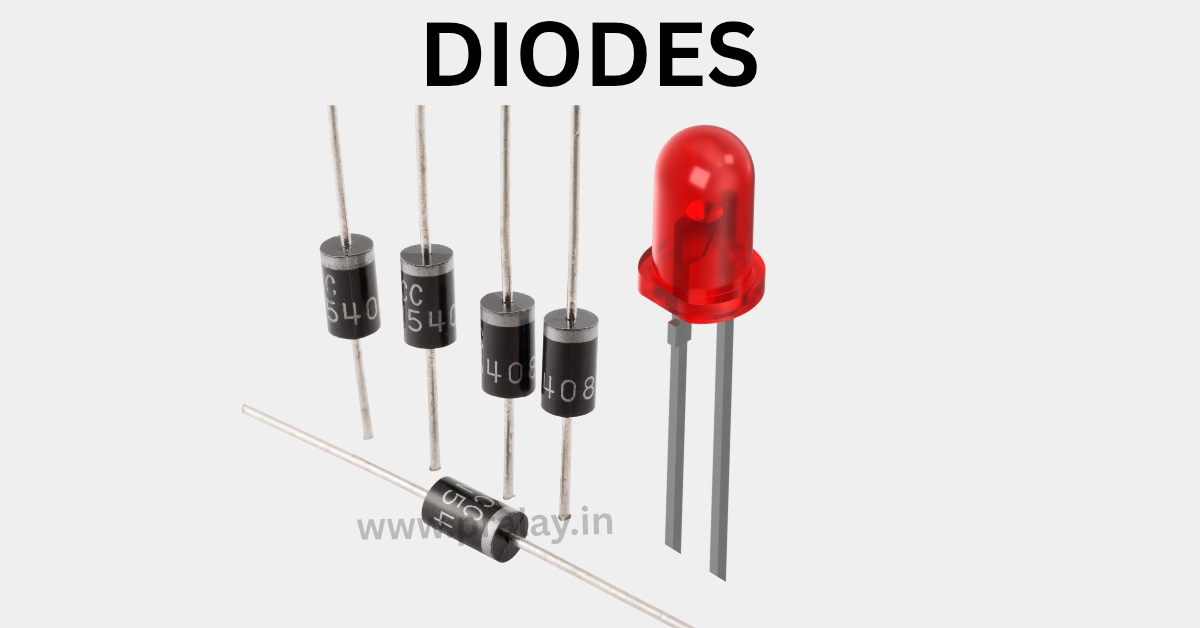
When it comes to modern electronics, the diode is one of the most fundamental and widely used components. Whether in power supplies, communication devices, rectifiers, or signal processors, diodes play a crucial role in controlling the direction of current. Understanding its structure, working, and applications provides the foundation for advanced electronics learning.
Introduction to Diode
A diode is a semiconductor device that allows current to flow in one direction while blocking it in the opposite direction. It acts as a switch or a one-way valve for electric current, making it essential in circuits where rectification or controlled conduction is needed. The unique ability of a diode to control current makes it one of the core building blocks of electronic circuits.
Definition of a Diode
A diode is defined as a two-terminal electronic component made from semiconductor material such as silicon or germanium. It permits current to flow when it is forward biased and blocks current when it is reverse biased. This directional property is what makes the diode so important in AC-to-DC conversion, signal demodulation, voltage regulation, and circuit protection.
Symbol of Diode

The symbol of a diode consists of a triangle pointing toward a line. The triangle represents the direction of current flow (from anode to cathode), while the line denotes the blocking end (cathode). This simple symbol captures the one-way current flow property of the device.
Related topics


Working Principle of a Diode
The working of a diode depends on the PN junction formed inside it. When a diode is forward biased, the depletion region between the P-type and N-type semiconductor reduces, allowing electrons and holes to recombine and current to flow. In reverse bias, the depletion layer widens, preventing the movement of carriers, and thus the current is blocked. This selective conduction is the heart of diode functionality.
Types of Diodes
Diodes are available in many forms, each designed for specific applications. Some of the most common types include:
- PN Junction Diode – The basic form used in rectification.
- Zener Diode – Designed for voltage regulation.
- Light Emitting Diode (LED) – Converts electrical energy into visible light.
- Photodiode – Converts light energy into electrical signals.
- Schottky Diode – Known for low forward voltage drop and fast switching.
- Tunnel Diode – Used in high-speed and microwave applications.
- Varactor Diode – Functions as a variable capacitor in RF circuits.
Function of a Diode
The primary function of a diode is rectification, which converts alternating current (AC) into direct current (DC). Beyond rectification, diodes are also used for signal demodulation, voltage stabilization, surge protection, logic gates in digital electronics, and in optoelectronics as light emitters and sensors.
Biasing of a Diode
Biasing refers to the way voltage is applied across the diode terminals:
- Forward Bias – When the positive terminal of a battery is connected to the anode and the negative terminal to the cathode, the diode conducts electricity.
- Reverse Bias – When the polarity is reversed, the diode blocks current except for a tiny leakage current. In certain diodes like Zener, reverse bias operation is intentionally used for regulation purposes.
Diode Circuit Applications
In practical circuits, diodes are used in many configurations. For instance, a half-wave rectifier circuit uses a single diode to allow only half of the AC waveform, while a full-wave rectifier uses multiple diodes for efficient conversion of AC to DC. LEDs are used in lighting and indicators, Zener diodes in voltage regulator circuits, and photodiodes in sensors and communication systems.
Frequently Asked Questions (FAQ) on Diodes
Q1. What is the main function of a diode?
The main function of a diode is to allow current to flow in one direction while blocking it in the opposite direction. This property makes it essential for rectification, signal control, and circuit protection.
Q2. What is forward bias and reverse bias in a diode?
In forward bias, the anode is connected to the positive terminal of the supply and the cathode to the negative, allowing current to flow. In reverse bias, the connections are reversed, and the diode blocks current except for a very small leakage.
Q3. What are the common types of diodes used in electronics?
Some common types include PN junction diodes, Zener diodes, LEDs, Schottky diodes, photodiodes, tunnel diodes, and varactor diodes. Each type is designed for specific applications like lighting, voltage regulation, or high-speed switching.
Q4. What is the symbol of a diode?
The diode symbol is a triangle pointing toward a line. The triangle represents the anode and direction of current flow, while the line represents the cathode.
Q5. Where are diodes used in real life?
Diodes are used in power supply rectifiers, LED lighting, communication circuits, voltage regulators, surge protectors, and sensors. They are present in nearly every modern electronic device.
Q6. Why is a diode called a rectifier?
A diode is often called a rectifier because it converts alternating current (AC) into direct current (DC) by allowing only one direction of current flow.
Q7. Can a diode work in reverse bias?
Yes, most diodes block current in reverse bias, but special diodes like Zener diodes and avalanche diodes are designed to operate in reverse bias for voltage regulation and protection purposes.
So friends, I’m Pralay Bhunia, I hope I’ve been able to help you with this information about Diode. If you have any more questions or suggestions, please feel free to share them in the comments. Your support always inspires me to share more new information.
External link
- Study.com: Diode | Meaning, Purpose & Types – Lesson