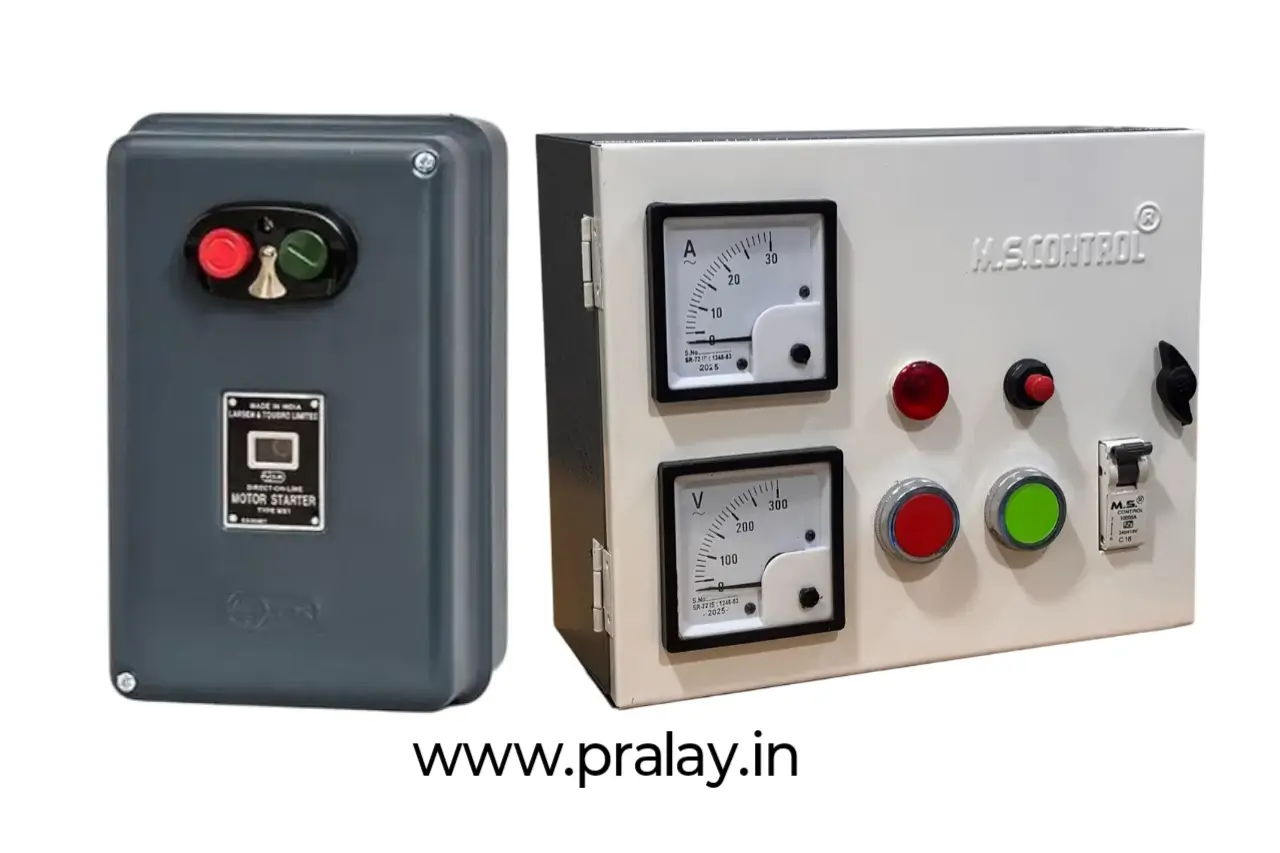
Electric motors are the backbone of modern industry. From water pumps and compressors to conveyors and manufacturing machines, three-phase induction motors power countless industrial systems. However, starting a motor directly from the power supply without protection can cause excessive current flow and potential damage. This is where the Direct-On-Line (DOL) starter plays a vital role.
A DOL starter is the simplest and most widely used motor starting method for three-phase induction motors. It connects the motor directly to the supply voltage while providing overload and short-circuit protection. Despite being simple in design, it remains one of the most reliable motor starting techniques used in industries worldwide.
What is a Direct-On-Line (DOL) Starter?
A Direct-On-Line starter is a motor starting device that applies full line voltage directly to the motor terminals. It includes protective components such as a contactor, overload relay, and push buttons to ensure safe motor operation.
When the Start button is pressed, the motor receives full supply voltage immediately. This results in high starting current (typically 6–8 times the rated current), which is acceptable for small motors but may not be suitable for large-capacity motors.
DOL starters are typically used for motors up to 5 HP to 10 HP, depending on supply conditions and industry standards.
Related topics


Construction of a DOL Starter
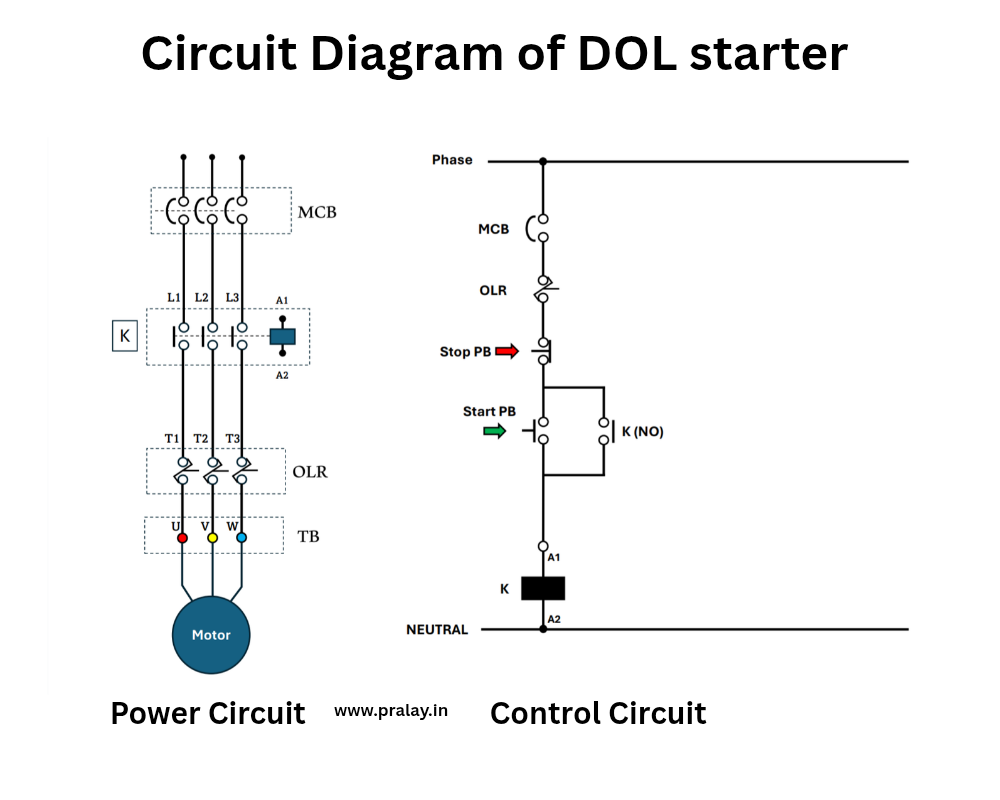
A DOL starter consists of two main circuits:
Power Circuit
This circuit carries the motor current. It includes:
- Main Contactor
- Overload Relay
- Three-Phase Supply (R, Y, B)
- Motor Terminals
Control Circuit
This circuit controls the operation of the contactor. It includes:
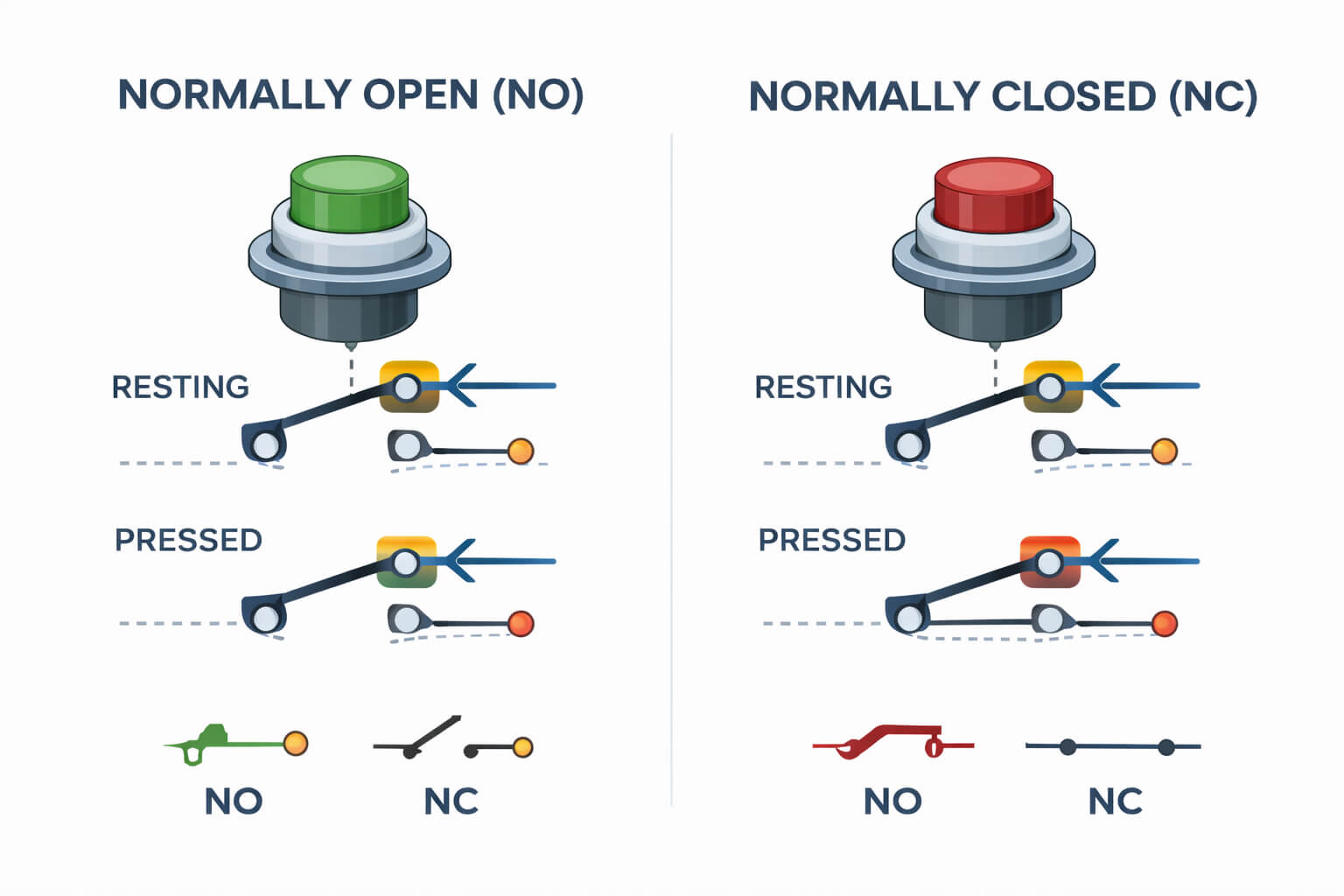
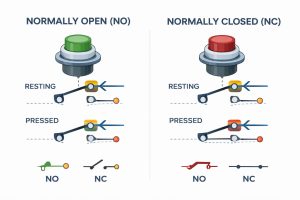
- Start Push Button (Normally Open – NO)
- Stop Push Button (Normally Closed – NC)
- Contactor Coil
- Auxiliary Holding Contact
The combination of power and control circuits ensures both operation and protection.
Circuit Diagram of DOL starter
Working Principle of DOL Starter
The working of a DOL starter is straightforward and efficient.
Step 1: Normal Condition
The Stop button (NC) remains closed, and the Start button (NO) remains open. The contactor coil is de-energized, and the motor is OFF.
Step 2: Pressing the Start Button
When the Start button is pressed:
- The circuit closes.
- Current flows to the contactor coil.
- The contactor energizes and closes the main contacts.
- The motor receives full supply voltage.
- The auxiliary holding contact maintains the circuit even after the Start button is released.
Step 3: Motor Running
The motor runs continuously as long as the contactor coil remains energized.
Step 4: Pressing the Stop Button
When the Stop button is pressed:
- The control circuit opens.
- The contactor coil de-energizes.
- Main contacts open.
- The motor stops immediately.
Step 5: Overload Condition
If motor current exceeds safe limits:
- The overload relay trips.
- The control circuit opens.
- The motor is disconnected automatically.
This makes the DOL starter both simple and safe.
Advantages of DOL Starter
The Direct-On-Line starter offers several practical benefits:
- Simple and economical design
- Easy installation and maintenance
- Reliable motor protection
- Compact size
- Suitable for small motors
- Provides overload protection
Due to its simplicity, it is widely used in small industrial setups and agricultural systems.
Disadvantages of DOL Starter
Despite its usefulness, the DOL starter has certain limitations:
- High starting current
- Voltage dip in supply line
- Mechanical stress on motor shaft
- Not suitable for large motors
Because of high inrush current, DOL starters are not recommended for high-capacity motors.
Applications of DOL Starter
Direct-On-Line starters are commonly used in:
- Water pumping systems
- Air compressors
- Small conveyor belts
- HVAC systems
- Agricultural motor systems
- Workshop machinery
- Small industrial plants
They are particularly effective where motor size is small and supply capacity is sufficient.
DOL Starter vs Star-Delta Starter:
| Parameter | DOL (Direct-On-Line) Starter | Star-Delta Starter |
|---|---|---|
| Starting Method | Motor connected directly to full line voltage | Motor starts in star connection, then switches to delta |
| Starting Current | High (6–8 times rated current) | Reduced (about 2–3 times rated current) |
| Starting Torque | High starting torque | Reduced starting torque |
| Circuit Complexity | Simple design | More complex with additional contactors and timer |
| Cost | Low | Higher than DOL |
| Installation | Easy and quick | Requires careful wiring and timing setup |
| Suitable Motor Size | Small motors (up to 5–10 HP) | Medium to large motors |
| Voltage Drop in Supply | High voltage dip possible | Lower voltage drop |
| Components Required | Contactor, overload relay, push buttons | Three contactors, timer, overload relay |
| Mechanical Stress | Higher due to full voltage start | Reduced mechanical stress |
| Maintenance | Low maintenance | Slightly higher maintenance |
| Application | Pumps, compressors, small machines | Industrial motors, large machinery |
| Efficiency at Start | Lower due to current surge | More controlled and efficient start |
| Power Requirement | Suitable where supply is strong | Suitable where supply capacity is limited |
| Safety | Basic motor protection | Improved protection and controlled starting |
Importance in Industrial Automation
In modern automation systems, DOL starters are often integrated with PLCs, timers, and protective relays. They form the foundation of motor control circuits and are commonly taught in engineering courses and vocational training programs.
Understanding DOL starter wiring and operation is essential for electrical engineers, technicians, and maintenance professionals.
Safety Considerations
While using a DOL starter, ensure:
- Proper earthing of motor
- Correct overload relay setting
- Proper contactor rating
- Adequate supply capacity
- Regular maintenance checks
Safety compliance prevents motor damage and electrical hazards.
Conclusion
The Direct-On-Line (DOL) starter remains one of the most practical and reliable motor starting methods in electrical engineering. Its simplicity, cost-effectiveness, and dependable performance make it ideal for small to medium-sized motors. Although it produces high starting current, it continues to serve industries efficiently when used appropriately.
For engineering students and professionals, mastering DOL starter operation is fundamental to understanding motor control systems and industrial automation.
Frequently Asked Questions (FAQ)
1. What is a DOL starter?
A Direct-On-Line (DOL) starter is a motor starting device that connects a three-phase motor directly to the full supply voltage.
2. Why is it called Direct-On-Line starter?
It is called Direct-On-Line because the motor is connected directly to the power line without voltage reduction.
3. Where is a DOL starter used?
DOL starters are commonly used for small three-phase motors in pumps, compressors, and workshop machinery.
4. What is the main advantage of a DOL starter?
Its main advantage is simplicity, low cost, and easy installation.
5. What is the main disadvantage of a DOL starter?
It produces high starting current, typically 6–8 times the rated current.
6. What components are used in a DOL starter?
It includes a contactor, overload relay, start and stop push buttons, and protective devices like MCB or fuse.
7. How does a DOL starter protect the motor?
It uses an overload relay to disconnect the motor during excessive current conditions.
8. What is the function of the overload relay in DOL?
The overload relay trips the circuit if motor current exceeds the safe limit.
9. What type of motors use DOL starters?
Three-phase squirrel cage induction motors are commonly started using DOL starters.
10. What happens when the Start button is pressed?
The contactor coil energizes, closing the main contacts and supplying full voltage to the motor.
11. What happens when the Stop button is pressed?
The control circuit opens, de-energizing the contactor and stopping the motor.
12. Is DOL suitable for large motors?
No, DOL is generally used for small motors because large motors can cause voltage dips due to high starting current.
13. What is the typical power rating for DOL starter use?
DOL starters are usually suitable for motors up to 5 HP to 10 HP, depending on system capacity.
14. What is a holding contact in DOL starter?
A holding or auxiliary contact maintains the circuit after the Start button is released.
15. How is DOL different from Star-Delta starter?
DOL applies full voltage at startup, while Star-Delta reduces starting voltage to limit current.
External links:
- Direct On-Line Motor Starters: Features and Performance – IC Components
- Everything you need to know about Direct On Line (DOL) motor starters – Schneider Electric