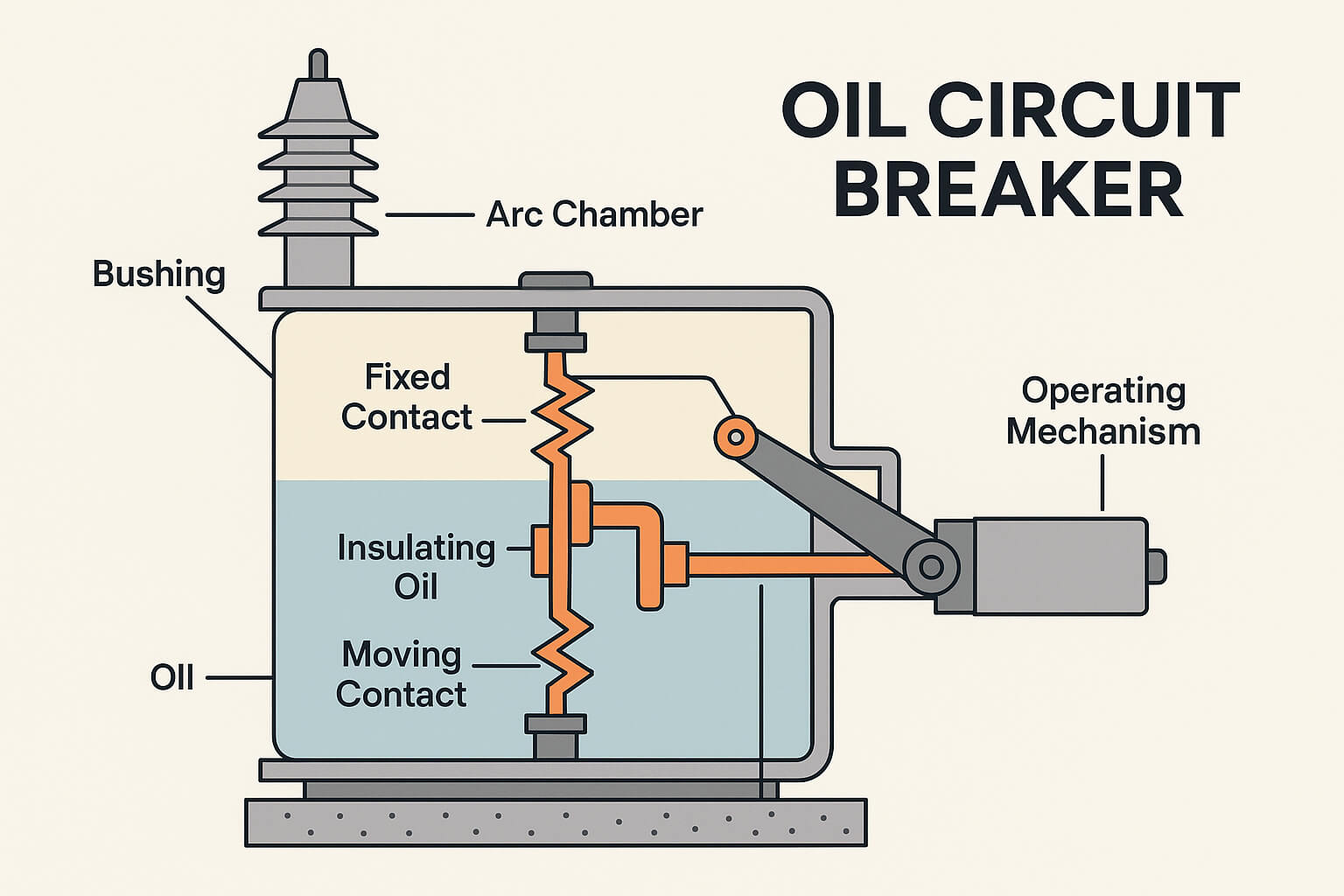
In electrical power systems, protecting equipment and human life from faults is one of the most critical responsibilities of engineers. Short circuits, overloads, and insulation failures can cause severe damage if not interrupted quickly and safely. Before modern technologies like vacuum and SF₆ circuit breakers became common, the Oil Circuit Breaker (OCB) played a vital role in medium- and high-voltage protection.
Oil Circuit Breakers were among the earliest circuit breakers used in power systems. They rely on insulating oil to extinguish the arc formed when electrical contacts separate. Even though many utilities are gradually replacing OCBs with newer technologies, understanding OCBs remains essential for electrical engineering students, maintenance engineers, and power system professionals.
What is an Oil Circuit Breaker (OCB)?
An Oil Circuit Breaker (OCB) is a type of circuit breaker in which oil is used as both an arc-quenching medium and an insulating medium. When a fault occurs, the breaker opens its contacts inside oil, and the arc formed is cooled and extinguished by the oil.
OCBs are generally used in medium-voltage and high-voltage systems, typically up to 33 kV and sometimes higher in older installations. The oil serves two important purposes: it absorbs the heat of the arc and provides electrical insulation between live parts and grounded components.
Why Oil is Used in Circuit Breakers
Oil has excellent dielectric strength and cooling properties. When an arc forms during contact separation, the intense heat decomposes the oil into hydrogen gas. This hydrogen has high thermal conductivity and helps cool the arc rapidly, causing it to extinguish.
Related topics


Key reasons oil is used include:
• High insulating capability
• Effective arc cooling
• Ability to withstand high fault currents
• Availability and ease of use in early power systems
However, oil also introduces certain risks, such as fire hazards and maintenance challenges, which led to the development of alternative technologies.
Working Principle of Oil Circuit Breaker
The working of an Oil Circuit Breaker is based on arc extinction using insulating oil.
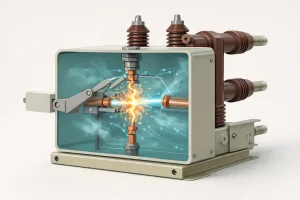
When the circuit breaker is closed, current flows normally through the contacts submerged in oil. During a fault, protective relays detect abnormal current and trigger the breaker mechanism. The contacts begin to separate inside the oil, and an arc is formed between them.
The heat of the arc causes the surrounding oil to decompose and release hydrogen gas. This gas surrounds the arc and cools it rapidly. As the current reaches zero (in AC systems), the arc is extinguished. The oil then regains its dielectric strength, preventing re-ignition of the arc.
This entire process happens within a fraction of a second, ensuring system protection.
Construction of an Oil Circuit Breaker
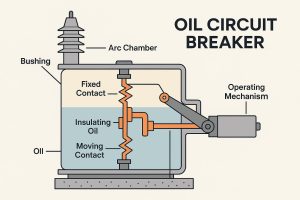
An Oil Circuit Breaker consists of several essential components designed to interrupt current safely.
1. Contacts
The breaker has fixed and moving contacts made of copper or copper alloys. These contacts open and close to interrupt the circuit.
2. Oil Tank
The contacts are housed in a sealed tank filled with insulating oil. The oil acts as both an arc-quenching and insulating medium.
3. Arc Chamber
Some OCBs include arc control devices that help direct and cool the arc efficiently.
4. Operating Mechanism
This mechanism may be manual, spring-loaded, or motor-operated. It provides the force needed to open and close the contacts quickly.
5. Bushings
Bushings allow external conductors to enter the oil tank while maintaining insulation.
6. Protective Relays
Relays detect faults and send signals to trip the breaker.
The design ensures safe operation but requires regular maintenance due to oil degradation over time.
Types of Oil Circuit Breakers
Oil Circuit Breakers are classified mainly into two types based on the quantity of oil used.
Bulk Oil Circuit Breaker (BOCB)
In this type, a large quantity of oil is used for both arc quenching and insulation. The oil surrounds all live parts.
Bulk oil circuit breakers were widely used in older substations and power stations. They are simple in design but require large oil volumes and regular maintenance.
Minimum Oil Circuit Breaker (MOCB)
In this type, a smaller quantity of oil is used only for arc quenching, while solid insulation is used elsewhere.
Minimum oil circuit breakers are more compact, safer, and economical compared to bulk oil types. They became popular as power systems evolved.
Advantages of Oil Circuit Breakers
Oil Circuit Breakers offered several benefits, especially during the early development of power systems.
• Good arc-quenching properties
• High dielectric strength
• Suitable for medium and high voltages
• Proven and well-understood technology
• Relatively simple construction
For decades, OCBs formed the backbone of power system protection across the world.
Disadvantages of Oil Circuit Breakers
Despite their advantages, OCBs have significant drawbacks that limit their use today.
• Risk of fire and explosion due to oil
• Requires frequent oil testing and replacement
• Large size and heavy weight
• Environmental pollution due to oil leakage
• Slower operation compared to modern breakers
• Carbonization of oil reduces insulation strength
Because of these limitations, most utilities are replacing OCBs with VCBs and SF₆ breakers.
Applications of Oil Circuit Breakers
Oil Circuit Breakers are still found in many older installations and some developing power systems.
They are used in:
• Old power substations
• Medium-voltage distribution networks
• Industrial power plants
• Rural electrical installations
• Backup and legacy systems
In many countries, OCBs continue to operate reliably where modern replacements are not yet implemented.
OCB vs SF₆ Circuit Breaker – Comparison Table
| Parameter | Oil Circuit Breaker (OCB) | SF₆ Circuit Breaker |
|---|---|---|
| Arc Quenching Medium | Insulating oil | Sulfur hexafluoride (SF₆) gas |
| Voltage Range | Medium to high voltage (up to ~33 kV, older systems higher) | High and extra-high voltage (33 kV to 800 kV) |
| Arc Extinction Method | Oil decomposes to hydrogen gas to cool arc | SF₆ gas absorbs electrons and extinguishes arc |
| Dielectric Strength | High | Very high (about 2–3 times air) |
| Size and Weight | Large and heavy | Compact and lightweight |
| Maintenance Requirement | High (oil testing, filtration, replacement) | Very low |
| Fire and Explosion Risk | High due to flammable oil | Very low |
| Environmental Impact | Oil leakage can cause pollution | SF₆ is a greenhouse gas if leaked |
| Operating Speed | Moderate | Very fast |
| Mechanical Life | Moderate | Very high |
| Reliability | Good but decreases with oil aging | Excellent and consistent |
| Cost | Lower initial cost | Higher initial cost |
| Installation | Requires oil handling facilities | Clean and easier installation |
| Typical Applications | Old substations, legacy systems | Modern HV substations and transmission lines |
| Current Industry Use | Gradually being phased out | Widely used in modern power systems |
Importance of Studying Oil Circuit Breakers
For electrical and mechanical engineers, understanding OCBs is important because:
• Many old substations still use OCBs
• Maintenance and retrofitting require OCB knowledge
• Power system evolution can be better understood
• Competitive exams and university curricula still include OCBs
OCBs represent an important step in the history of electrical engineering.
Future of Oil Circuit Breakers
The future of Oil Circuit Breakers is limited. Environmental regulations, safety concerns, and maintenance costs have pushed utilities toward vacuum and gas-based technologies. However, OCBs will continue to exist in legacy systems for many years.
Modern research focuses on oil-free, maintenance-free, and eco-friendly circuit breakers. Nevertheless, OCBs remain a valuable learning tool and a reminder of how far power protection technology has advanced.
Conclusion: The Oil Circuit Breaker played a crucial role in the development of electrical power systems. By using oil as an arc-quenching and insulating medium, it provided reliable protection for decades. Although newer technologies like Vacuum and SF₆ Circuit Breakers have largely replaced OCBs, their importance in electrical engineering education and legacy systems remains strong.
Frequently Asked Questions (FAQ)
1. What is an Oil Circuit Breaker (OCB)?
An Oil Circuit Breaker is a protective device that uses insulating oil to extinguish the arc formed during fault interruption in electrical power systems.
2. Why is oil used in circuit breakers?
Oil has high dielectric strength and excellent cooling properties, which help extinguish electrical arcs quickly and safely.
3. What voltage levels are OCBs used for?
OCBs are mainly used in medium-voltage systems, typically up to 33 kV, and in some older high-voltage installations.
4. How does an Oil Circuit Breaker work?
When contacts separate during a fault, an arc forms in oil. The oil decomposes into hydrogen gas, which cools and extinguishes the arc.
5. What are the main parts of an OCB?
Key parts include contacts, oil tank, arc chamber, operating mechanism, bushings, and protective relays.
6. What are the types of Oil Circuit Breakers?
The two main types are Bulk Oil Circuit Breakers (BOCB) and Minimum Oil Circuit Breakers (MOCB).
7. What is a Bulk Oil Circuit Breaker?
In a BOCB, a large quantity of oil is used for both arc quenching and insulation of live parts.
8. What is a Minimum Oil Circuit Breaker?
A MOCB uses a smaller quantity of oil only for arc extinction, while solid insulation is used elsewhere.
9. What are the advantages of Oil Circuit Breakers?
They offer good arc-quenching performance, high dielectric strength, and proven reliability in power systems.
10. What are the disadvantages of OCBs?
They have fire risk, require frequent maintenance, are bulky, and oil quality degrades over time.
11. Why are OCBs being replaced today?
Modern breakers like VCBs and SF₆ breakers are safer, smaller, require less maintenance, and are more reliable.
12. Are Oil Circuit Breakers still used today?
Yes, they are still found in older substations and legacy power systems, especially in developing regions.
13. What maintenance is required for OCBs?
Regular oil testing, filtration, replacement, and inspection of contacts are necessary to ensure safe operation.
14. How do OCBs compare with Vacuum Circuit Breakers?
OCBs use oil and require more maintenance, while VCBs use vacuum, are compact, safer, and maintenance-free.
15. Why should engineers study Oil Circuit Breakers?
OCBs are important for understanding the evolution of power system protection and maintaining older installations.
External Links
1. IEC – International Electrotechnical Commission
https://www.iec.ch
Official global standards for circuit breakers, switchgear, and electrical protection devices.
2. IEEE Xplore – Circuit Breaker Research
https://ieeexplore.ieee.org
Peer-reviewed technical papers on oil circuit breakers, arc extinction, and power system protection.