The synchronous motor is a highly efficient and precise AC motor widely used in industrial, commercial, and advanced control systems. Its ability to run at a constant speed regardless of load makes it fundamentally different from most other AC motors. In applications where speed accuracy, power factor correction, or precise timing is required, the synchronous motor becomes a preferred choice. It stands as a crucial element in power plants, manufacturing units, automation technology, transportation systems, and robotics. This article presents a detailed and SEO-friendly explanation of synchronous motors, focusing on their working principle, characteristics, construction, types, and applications in today’s technology-driven world.
What is a Synchronous Motor?
Definition: A synchronous motor is an AC motor that operates at a constant speed and rotates in synchronization with the frequency of the supply voltage. This means its rotor speed matches exactly with the rotating magnetic field produced by the stator. Unlike induction motors, which operate with slip, synchronous motors do not rely on induced current for their operation. Instead, they may use permanent magnets, DC excitation, or electromagnetic field systems to maintain precise speed control.
This unique property makes synchronous motors ideal for tasks requiring steady speed, phase synchronization, or power factor improvement. According to industrial studies, more than 30% of manufacturing systems use synchronous motors when strict speed control is necessary.
Working Principle of Synchronous Motor
The working principle of a synchronous motor is based on the interaction between a rotating magnetic field (RMF) and a magnetic rotor that locks onto that field. When three-phase AC current flows through the stator windings, it creates a rotating magnetic field whose speed depends on the supply frequency. This speed is known as synchronous speed, defined by the formula:
Ns = 120 × f / P
Where:
Ns = synchronous speed (in RPM)
f = supply frequency (in Hz)
P = number of poles in the motor
Related topics


To achieve synchronization, the rotor usually contains either permanent magnets or a DC-excited winding. Once energized, the magnetic rotor aligns itself with the RMF and rotates at the same speed. Importantly, a synchronous motor does not self-start. It requires external assistance such as a damper winding, pony motor, frequency control, or inverter-based soft starter to initiate motion before locking into synchronous speed.
Once synchronized, the motor maintains constant speed even under varying loads, making it extremely valuable in precision systems.
Construction of Synchronous Motor
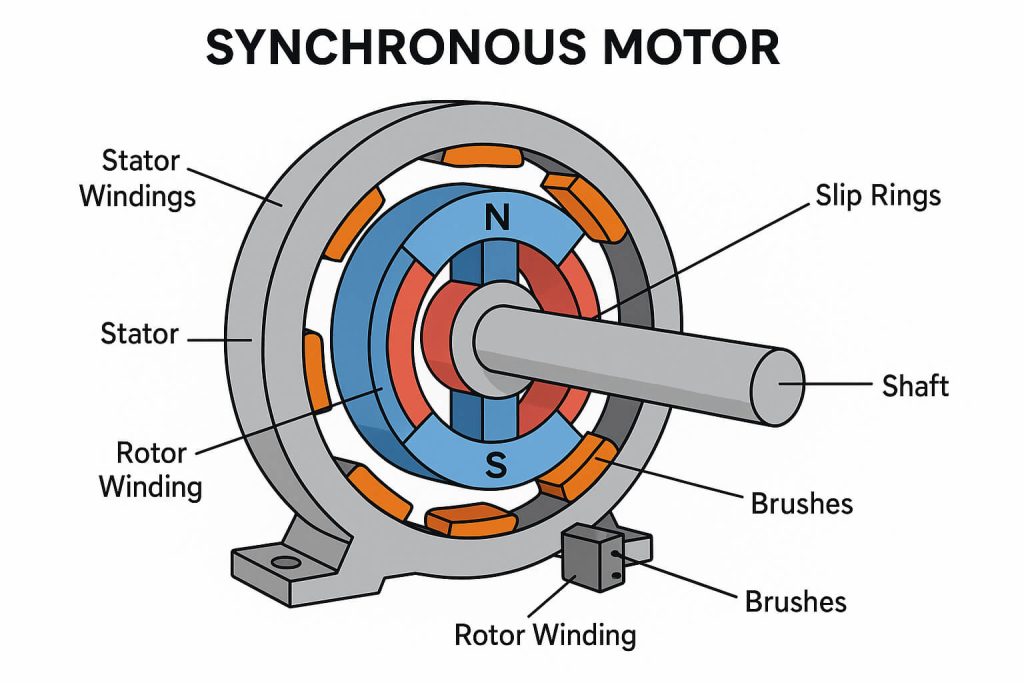
A synchronous motor consists of two main parts: the stator and the rotor. The stator includes three-phase windings arranged to generate a rotating magnetic field. The rotor differs based on design type—it may contain permanent magnets, DC excitation windings, or salient poles.
In motors that use DC excitation, slip rings and brushes are included to feed DC supply to the rotor winding. Damper windings are sometimes added to aid smooth starting and provide temporary functionality similar to induction motors.
The air gap between stator and rotor is carefully maintained to allow efficient magnetic interaction. High-grade electrical steel and copper windings are used to reduce losses and increase efficiency. Modern synchronous motors may include sensors, VFDs, control modules, and feedback systems for automation and real-time speed regulation.
Types of Synchronous Motors
Several forms of synchronous motors are used depending on application requirements, excitation method, and structural design. Permanent magnet synchronous motors use strong magnets on the rotor and are widely used in robotics, electric vehicles, and servo systems due to their efficiency and compactness. The DC-excited version is used in heavy machinery and alternators, where adjustable field control is beneficial.
Reluctance synchronous motors utilize magnetic reluctance between rotor poles to achieve synchronization. They are robust, economical, and found in pumps, compressors, and industrial drives. Servo synchronous motors offer highly precise angular and speed control, commonly used in CNC machines, automation, and robotics.
Each type is chosen based on required torque, cost-effectiveness, efficiency, and speed regulation capability.
Advantages of Synchronous Motor
One of the major advantages of a synchronous motor is its ability to run at constant speed, which remains unaffected by load changes. This characteristic makes it superior to induction motors in speed-sensitive applications. The power factor can be adjusted to leading or lagging by controlling rotor excitation, which helps improve overall system efficiency. This makes synchronous motors valuable as power factor correction devices in large industrial networks.
Synchronous motors also provide high efficiency, reduced energy consumption, and excellent performance in high-load operations. Their construction allows long operational life with low maintenance, especially in brushless or permanent magnet versions. Modern synchronous motors combined with VFD technology offer unprecedented control in industrial automation.
Applications of Synchronous Motor
Synchronous motors have vast applications across domestic, commercial, and industrial fields. In precision tools and clock mechanisms, their constant speed ensures accurate timing and synchronization. In industrial environments, synchronous motors are used in compressors, crushers, blowers, and conveyors where efficiency and reliability are critical.
Power stations and utility networks use synchronous motors as synchronous condensers to improve power factor and stabilize voltage levels. Textile mills, paper processing units, and printing industries utilize synchronous motors for continuous and accurate operation. They are also widely used in electric traction, high-performance pumps, elevators, refrigeration systems, and servo-controlled automation systems.
The growth of electric vehicles (EVs) and robotics has significantly increased demand for permanent magnet synchronous motors (PMSM), which provide high torque density and excellent efficiency in battery-powered systems.
Importance in Modern Technology
The rapid development of renewable energy systems, smart manufacturing, and automated control has made synchronous motors more relevant than ever. Their precise control and energy-saving capabilities align with modern sustainability standards. As industries adopt Industry 4.0 and digital automation, the role of synchronous motors will continue to expand. With advancements in materials, control electronics, and AI-based predictive maintenance systems, synchronous motors are becoming more powerful, efficient, and adaptive.
Future trends indicate widespread integration of synchronous motors in clean energy solutions, autonomous vehicles, robotics, and smart infrastructure technologies. The combination of permanent magnet technology and intelligent control systems is making synchronous motors an essential pillar of modern electromechanical engineering.
Sure! Below is a clear and SEO-friendly comparison between a synchronous motor and an induction motor, written in point-based format as requested. It is WordPress-ready and suitable for educational or technical blog posts.
Synchronous Motor vs Induction Motor
Synchronous motors and induction motors are both widely used in AC systems, but their working methods and characteristics differ significantly. The following points explain the major differences:
1. Operating Principle
• A synchronous motor runs at constant speed and rotates in exact synchronization with the supply frequency.
• An induction motor works based on electromagnetic induction and operates at a speed slightly less than synchronous speed due to slip.
2. Speed Characteristics
• Synchronous motor operates at constant speed (no slip).
• Induction motor speed varies slightly depending on load (has slip).
3. Starting Method
• Synchronous motors do not self-start and require additional starting mechanisms.
• Induction motors are self-starting and simple to operate.
4. Power Factor Capability
• Synchronous motors can operate at lagging, leading, or unity power factor — making them useful for power correction.
• Induction motors generally run at lagging power factor and cannot correct the system power factor.
5. Efficiency
• Synchronous motors offer higher efficiency at full load conditions.
• Induction motors have slightly lower efficiency due to rotor losses and slip.
6. Maintenance Requirement
• Synchronous motors need more complex maintenance (DC supply, slip rings, etc.).
• Induction motors require low maintenance and are more rugged.
7. Cost and Industrial Use
• Synchronous motors are more expensive and used where speed precision is required.
• Induction motors are economical and widely used in industrial drives and household appliances.
8. Applications
• Synchronous motors are used in power plants, automation, CNC machines, robotics, and compressors.
• Induction motors are used in fans, pumps, elevators, blowers, conveyors, and industrial machinery.
In Summary
| Feature | Synchronous Motor | Induction Motor |
|---|---|---|
| Speed | Constant | Varies with load (slip) |
| Starting | Requires external starter | Self-starting |
| Power Factor | Can improve system PF | Always lagging |
| Cost | Higher | Lower |
| Use Case | Precision control | General-purpose use |
Frequently Asked Questions – FAQ
1. What is a synchronous motor?
A synchronous motor is an AC motor that rotates at the same speed as the rotating magnetic field of the stator.
2. Why is it called a synchronous motor?
It is called synchronous because its rotor speed matches the supply frequency without slip.
3. What is the basic working principle of a synchronous motor?
It works using the interaction between a rotating magnetic field and a magnetized rotor, causing continuous rotation at constant speed.
4. Does a synchronous motor self-start?
No, it usually requires an external starting method such as a damper winding, pony motor, or inverter.
5. What is synchronous speed?
Synchronous speed is calculated using Ns = 120 × f / P, where f is frequency and P is the number of poles.
6. What are the main types of synchronous motors?
The main types include permanent magnet, reluctance, and DC-excited synchronous motors.
7. Where are synchronous motors used?
They are used in power plants, compressors, robotics, conveyors, automation systems, and servo mechanisms.
8. What are the advantages of synchronous motors?
They offer constant speed, high efficiency, and power factor correction capability.
9. What is the difference between synchronous and induction motor?
A synchronous motor runs at constant speed without slip, while an induction motor operates at a slightly lower speed due to slip.
10. Can a synchronous motor improve power factor?
Yes, it can operate as a synchronous condenser to correct power factor in electrical systems.
11. What are the rotor types used in synchronous motors?
The rotor may use permanent magnets, salient poles, or DC excitation winding.
12. Why is DC supply required for the rotor?
In certain designs, DC supply magnetizes the rotor to achieve synchronization with the stator field.
13. What happens if load increases on a synchronous motor?
Its speed remains constant, but torque and power consumption increase to maintain operation.
14. Can synchronous motors be used for variable speed control?
Yes, with the use of a Variable Frequency Drive (VFD), precise control is possible.
15. Are synchronous motors used in electric vehicles?
Yes, especially Permanent Magnet Synchronous Motors (PMSM), which provide high torque and efficiency.
So friends, I’m Pralay Bhunia, I hope I’ve been able to help you with this information about synchronous motors. If you have any more questions or suggestions, please feel free to share them in the comments. Your support always inspires me to share more new information.