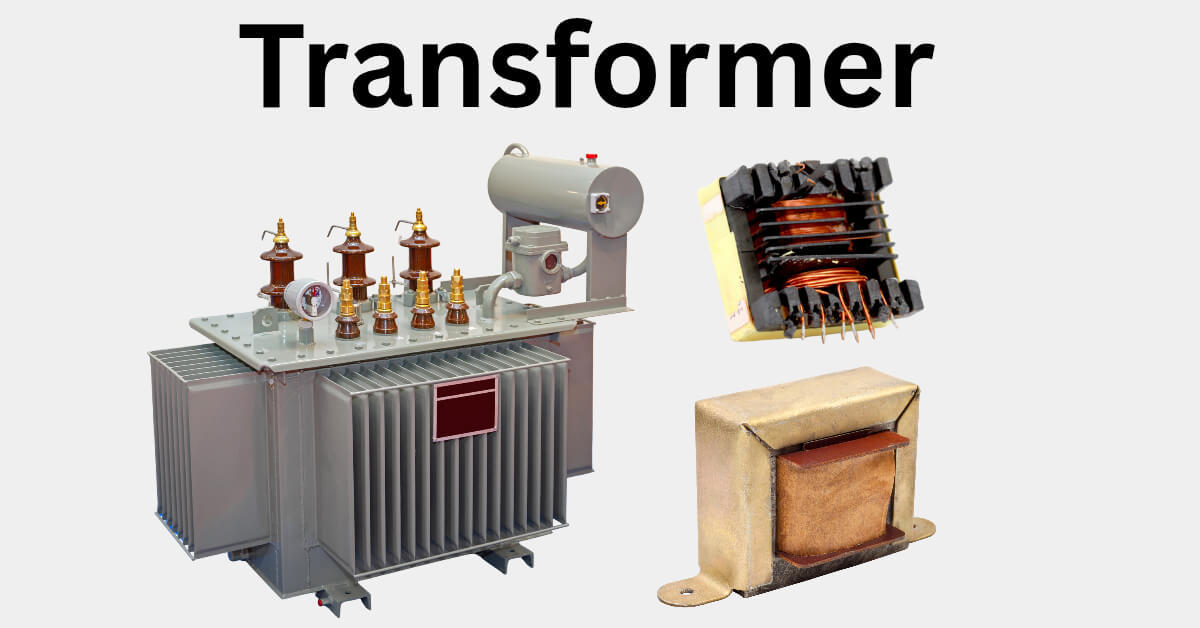
Introduction: Electrical power systems are the backbone of modern civilization, delivering electricity across vast distances to homes, industries, and commercial establishments. One of the most critical components that makes this possible is the transformer. Widely used in power generation, transmission, and distribution networks, transformers enable the efficient transfer of electrical energy by adjusting voltage levels without changing frequency.
What is a transformer?
Definition of Transformer: A transformer is a static electrical machine that transfers alternating current (AC) electrical power from one circuit to another through the principle of electromagnetic induction. It increases (step-up) or decreases (step-down) the voltage while maintaining the same power (neglecting losses). The frequency of the electrical signal remains unchanged.
In simple terms:
- If the voltage is stepped up, the current decreases proportionally.
- If the voltage is stepped down, the current increases proportionally.
- This makes transformers essential for minimizing power losses during long-distance transmission and for delivering safe voltages to end users.
What is the transformer principle?
The operation of a transformer is based on Faraday’s Law of Electromagnetic Induction, which states that a changing magnetic flux in a coil induces an electromotive force (EMF) in a nearby coil.
Working Principle of Transformer
1. An alternating current flows through the primary winding, creating a time-varying magnetic flux in the transformer’s core.
2. This magnetic flux links with the secondary winding through the core.
Related topics

3. According to Faraday’s law, an EMF is induced in the secondary winding proportional to the rate of change of flux.
4. The ratio of primary to secondary voltage depends on the turns ratio of the windings:
\( \frac{V_1}{V_2} = \frac{N_1}{N_2} \)
Main Components of a Transformer:
Core: Provides a low-reluctance path for magnetic flux. Usually made of laminated silicon steel to reduce eddy current losses.
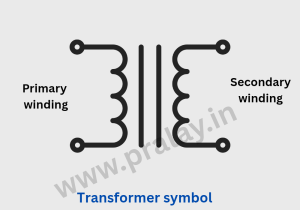
Primary Winding: Connected to the input power source.
Secondary Winding: Delivers the transformed voltage to the load.
Insulation & Tank: Protects and supports the windings while preventing short circuits.
Transformer Symbol
Types of Transformers:
Transformers can be classified based on several factors:
1. Based on Function
Step-Up Transformer: Increases voltage and decreases current (used in power transmission).
Step-Down Transformer: Decreases voltage and increases current (used in distribution and household applications).
2. Based on Phases
Single-Phase Transformer: Used for low-power applications such as residential supply.
Three-Phase Transformer: Used in industries and high-power transmission systems.
3. Based on Core Construction
Core-Type Transformer: Windings surround a large portion of the core.
Shell-Type Transformer: Core surrounds a large portion of the windings.
4. Special Types
Autotransformer: A single winding acts as both primary and secondary, offering variable voltage.
Instrument Transformer: Includes potential transformers (PT) and current transformers (CT) for measurement and protection.
Distribution Transformer: Supplies electricity at low voltages for consumer use.
Power Transformer: Handles high voltages in transmission networks.
Applications of Transformers
- Power generation and transmission
- Voltage regulation in distribution systems
- Electrical isolation for safety
- Measurement and protection in power systems
- Domestic appliances (e.g., adapters, chargers)
So friends, I’m Pralay Bhunia, I hope I’ve been able to help you with this information about transformers. If you have any more questions or suggestions, please feel free to share them in the comments. Your support always inspires me to share more new information.
Frequently Asked Questions (FAQ) on Transformers
Q1. What is a transformer in simple words?
A transformer is a device that changes the voltage of alternating current (AC) electricity without changing its frequency. It can increase (step up) or decrease (step down) the voltage.
Q2. Why do we use transformers in power systems?
Transformers are used to:
- Reduce power loss during long-distance transmission by stepping up voltage.
- Supply safe and usable voltage levels to consumers by stepping down voltage.
- Provide electrical isolation for safety.
Q3. What are the main parts of a transformer?
The main components are:
- Core (for magnetic flux flow)
- Primary winding (connected to the input supply)
- Secondary winding (connected to the load)
- Insulation and tank (for safety and protection)
Q4. What is the difference between step-up and step-down transformers?
Step-Up Transformer: Increases voltage and decreases current (used in transmission).
Step-Down Transformer: Decreases voltage and increases current (used in distribution and appliances).
Q5. Does a transformer work with direct current (DC)?
No. Transformers only work with alternating current (AC) because their operation is based on electromagnetic induction, which requires a changing magnetic flux.
Q6. What are the losses in a transformer?
Transformers are highly efficient, but they still have some losses:
- Core losses (hysteresis and eddy current losses)
- Copper losses (resistance of windings)
- Leakage flux losses
Q7. What is the efficiency of a transformer?
Most transformers have very high efficiency, usually in the range of 95% to 99%, depending on size and design.
Q8. What is the difference between power transformer and distribution transformer?
Power Transformer: Used in transmission networks, operates at high voltages, designed for maximum efficiency at full load.
Distribution Transformer: Used in local distribution, operates at lower voltages, designed to handle variable loads.
Q9. What is an autotransformer?
An autotransformer is a special type of transformer that uses a single winding as both primary and secondary, with a tapping point to provide different voltage levels.
Q10. Can a transformer change frequency?
No. A transformer only changes voltage and current levels, not frequency. The input and output frequency remain the same.