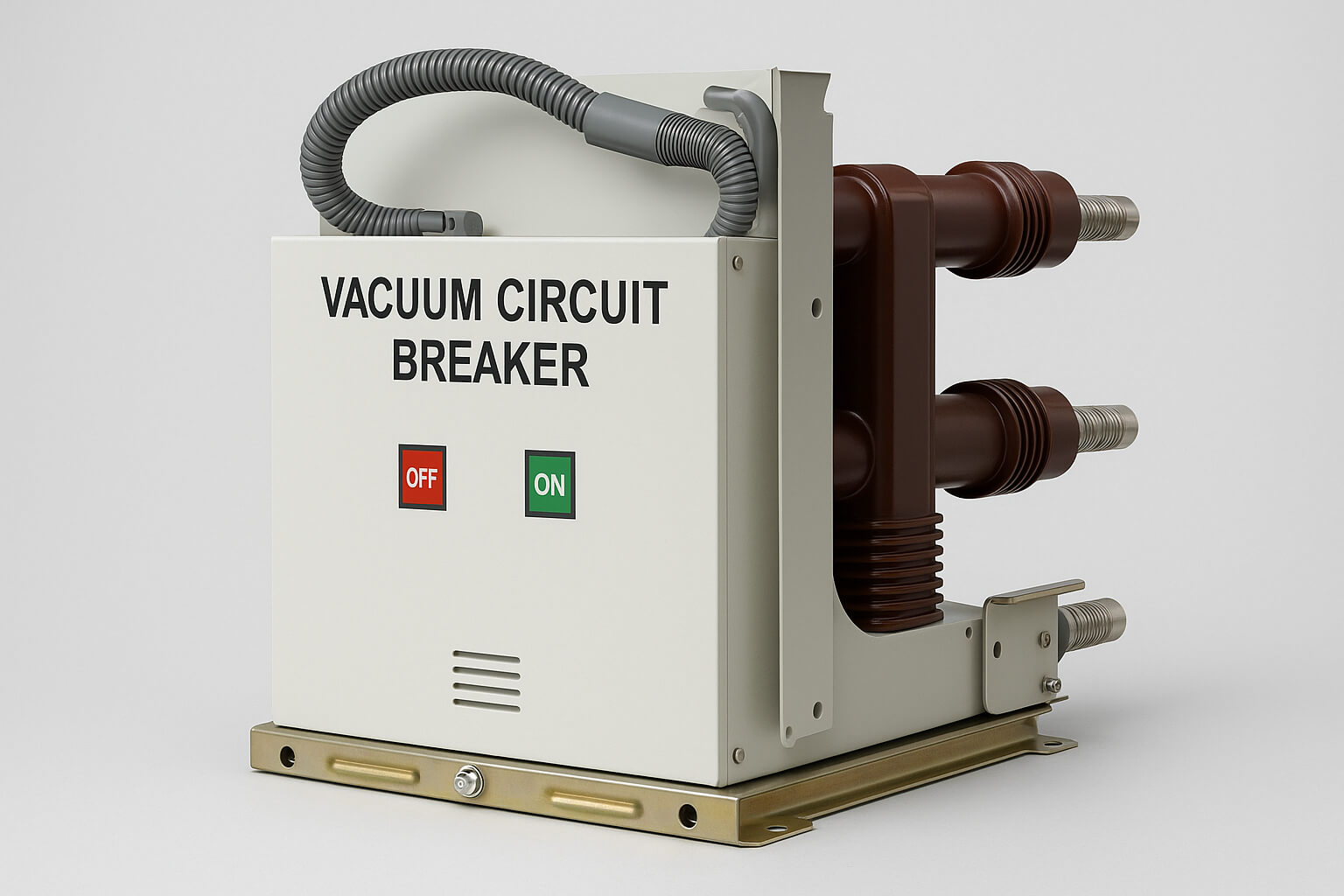
Vacuum Circuit Breakers (VCBs): Modern electrical power systems depend heavily on reliable protection devices to ensure safety, continuity, and stability. Among the many circuit breakers used today, the Vacuum Circuit Breaker (VCB) has become one of the most trusted technologies for medium-voltage applications. Its ability to extinguish arcs efficiently, operate with minimal maintenance, and offer long-term durability makes it a preferred choice in industries, substations, renewable energy plants, and distribution networks.
Before vacuum technology existed, engineers relied on oil and air circuit breakers. These older systems required more maintenance, suffered from environmental risks, and were less efficient. The introduction of vacuum interrupters revolutionized power system protection by providing clean, fast, and highly reliable arc extinction.
What is a Vacuum Circuit Breaker (VCB)?
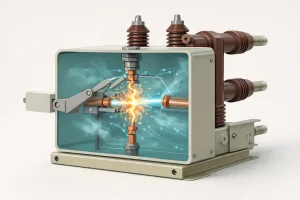
A Vacuum Circuit Breaker is a type of electric switchgear used for medium-voltage protection, typically ranging from 3 kV to 38 kV. As the name suggests, the arc is extinguished inside a vacuum chamber, known as the vacuum interrupter.
In vacuum, there are no gas molecules to sustain an arc. Once the contacts separate, the arc forms for a very short time and immediately extinguishes due to the absence of ionized particles. This makes VCBs extremely efficient in interrupting high fault currents safely.
VCBs are widely used in:
Related topics

- Medium-voltage switchgear
- Industrial power distribution
- Mining operations
- Power plants
- Renewable energy systems (wind, solar, hydro)
- Grid substations
They are known for long lifespan, minimal maintenance, and environmental friendliness.
Why Vacuum Is Used in VCBs
Vacuum has excellent dielectric strength—much higher than air or SF₆ gas. When current flows and contacts separate, an arc forms momentarily. Because vacuum contains no oxygen, nitrogen, or other gas molecules, the arc cannot sustain itself. It collapses almost instantly.
Benefits of using vacuum:
- No risk of fire or explosion
- No greenhouse gases
- Excellent insulation properties
- Very fast arc interruption
- Longer lifetime of contact materials
From a scientific perspective, vacuum interrupters reduce arc energy, minimize heat stress, and ensure safe fault isolation.
Working Principle of a Vacuum Circuit Breaker
The working of a VCB is based on the arc extinction in vacuum and the current-zero phenomenon.
How VCB Works Step-by-Step
- Normal operation:
The breaker contacts remain closed, and current flows normally. - Fault occurs (overload or short circuit):
Protective relays detect abnormal current and send a trip signal. - Contact separation:
When the contacts move apart, an arc forms due to metal vapor ions. - Arc extinction:
As the current passes through zero (AC waveform), the metal vapor condenses, and the arc dies instantly due to the vacuum. - Circuit isolation:
With no ionized particles left, the vacuum interrupter restores dielectric strength and successfully blocks current flow.
This rapid and clean interruption is the reason VCBs are preferred in high-demand environments.
Construction of a Vacuum Circuit Breaker
A typical VCB consists of several essential components that work together for reliable operation.
1. Vacuum Interrupter
The heart of the VCB. It contains:
- Fixed contact
- Moving contact
- Metal bellows
- Ceramic or glass enclosure
- Arc shield
It is sealed permanently and can operate thousands of times without needing replacement.
2. Operating Mechanism
Controls the movement of contacts. Common mechanisms include:
- Spring-charged
- Magnetic actuator
- Motorized mechanism
This mechanism ensures fast opening and closing.
3. Insulating Housing
Encases the interrupter and provides external insulation. Often made of epoxy resin or metal-clad enclosures.
4. Arc Shield
Protects the interrupter walls from metal vapor deposition during arc formation.
5. Terminal Bushings
Provide electrical connection to incoming and outgoing circuits.
VCB construction is extremely compact, durable, and designed for harsh industrial environments.
Types of Vacuum Circuit Breakers
VCBs can be classified based on their design and operating mechanism.
1. Indoor VCBs
Used in buildings, substations, and industrial switchgear. Compact and safer for indoor applications.
2. Outdoor VCBs
Installed in open switchyards, typically mounted on poles or frames. Designed to withstand weather conditions.
3. Fixed Type VCBs
Permanently installed inside the switchgear. Compact and economical.
4. Draw-out Type VCBs
Can be removed easily for maintenance without disrupting system wiring. Popular in industries.
Each type is selected based on voltage level, environmental conditions, and maintenance preferences.
Advantages of Vacuum Circuit Breakers
VCBs dominate the medium-voltage sector for several reasons:
High Dielectric Strength
Vacuum provides exceptional insulation even when contacts are close together.
Minimal Maintenance
Vacuum interrupters require almost no maintenance for decades.
Long Mechanical and Electrical Life
VCBs can perform over 30,000 to 50,000 operations, making them ideal for repetitive switching.
No Fire or Explosion Risk
No oil or gas is used, eliminating safety hazards.
Environmentally Friendly
Unlike SF₆ breakers, VCBs do not release greenhouse gases.
Fast Arc Extinction
The arc lasts only microseconds, reducing damage to contacts.
Compact and Lightweight
Easy to install and handle.
These advantages make VCBs ideal for power distribution networks worldwide.
Limitations of Vacuum Circuit Breakers
Although VCBs are extremely reliable, they do have some limitations:
- Not suitable for very high voltages above 66 kV
- More expensive than air circuit breakers
- Requires precise manufacturing technology
- Limited use in extremely high-frequency switching applications
Despite these limitations, VCBs remain the best option for medium-voltage applications.
Applications of Vacuum Circuit Breakers
VCBs are used wherever medium-voltage protection is required.
1. Industrial Power Distribution
Protects motors, compressors, conveyors, and heavy machinery.
2. Substations and Switchyards
Ensures safe power distribution in urban and rural grids.
3. Power Plants
Used in generator terminals, transformers, and auxiliary circuits.
4. Renewable Energy Systems
Essential for wind turbines, solar farms, and hydroelectric plants.
5. Mining and Oil Industries
Withstand harsh environmental conditions and repeated switching.
6. Commercial Buildings and Malls
Offer safe protection for large HVAC and electrical systems.
VCBs have become the standard solution in most medium-voltage installations globally.
VCB vs ACB – Comparison Table
| Parameter | VCB (Vacuum Circuit Breaker) | ACB (Air Circuit Breaker) |
|---|---|---|
| Full Form | Vacuum Circuit Breaker | Air Circuit Breaker |
| Arc Quenching Medium | Vacuum | Air |
| Voltage Range | Medium Voltage (3 kV to 38 kV) | Low Voltage (up to 690V) |
| Breaking Capacity | Very high | High (but lower than VCB) |
| Arc Duration | Extremely short (microseconds) | Longer compared to VCB |
| Ideal Application | Medium-voltage switchgear, industrial feeders, substations | LV distribution, panels, industrial MCCs |
| Maintenance Requirement | Very low, long lifespan | Moderate, periodic servicing required |
| Environmental Impact | No gases, eco-friendly | Air is safe and natural |
| Mechanical Life | Very high (30,000–50,000 operations) | Moderate (10,000–20,000 operations) |
| Size and Weight | Compact for MV systems | Larger and heavier in LV systems |
| Operating Speed | Faster | Slower than VCB |
| Cost | Higher | Moderate |
| Safety Level | High — sealed vacuum interrupter | High — air-insulated open mechanism |
| Reliability | Excellent in harsh and repetitive switching conditions | Reliable but less stable for MV fault levels |
| Suitable For | Power plants, grid substations, mining, renewable energy | Commercial buildings, industries, generator panels |
Importance of VCB in Modern Power Systems
As power systems evolve with renewable energy, smart grids, and automation, the demand for reliable protection increases. VCBs support these developments by offering:
- High switching performance
- Environmental sustainability
- Long operational life
- Compatibility with intelligent switchgear
Their role will only grow as energy systems become more complex and efficient.
Conclusion: A Vacuum Circuit Breaker is a powerful, efficient, and environmentally friendly protection device essential for medium-voltage applications. Its ability to interrupt faults quickly, operate for decades with minimal maintenance, and ensure electrical safety makes it one of the most important components in modern power networks.
Frequently Asked Questions (FAQ)
1. What is a Vacuum Circuit Breaker (VCB)?
A VCB is a medium-voltage circuit breaker that uses vacuum as the arc-extinguishing medium. It provides fast and reliable protection from electrical faults.
2. Why is vacuum used in circuit breakers?
Vacuum has extremely high dielectric strength and contains no gases to sustain the arc. This allows very fast arc extinction and excellent insulation.
3. What voltage range does a VCB operate in?
VCBs typically operate between 3 kV and 38 kV, making them suitable for medium-voltage applications.
4. How does a VCB extinguish the arc?
When the contacts separate, the arc forms briefly. Due to the absence of gas molecules in vacuum, the arc collapses instantly at current zero.
5. What is a vacuum interrupter?
It is the sealed chamber where arc formation and arc extinction occur. It contains fixed contacts, moving contacts, and metal shields.
6. What are common applications of VCBs?
VCBs are used in substations, power plants, mining operations, industrial switchgear, renewable energy systems, and distribution networks.
7. Are VCBs environmentally friendly?
Yes. VCBs use no oil or SF₆ gas, making them safe and environmentally sustainable.
8. How long does a VCB last?
VCBs have an excellent lifespan, often exceeding 30,000 to 50,000 mechanical operations with very little maintenance.
9. What causes a VCB to trip?
Overload, short circuits, earth faults, or issues detected by protective relays trigger the breaker to open.
10. Is maintenance required for VCBs?
Maintenance is minimal. Periodic inspection of mechanical parts and insulation is usually sufficient.
11. What is the main advantage of VCB over ACB?
VCBs offer faster arc extinction, higher lifespan, and better performance at medium voltages, whereas ACBs are used only for low voltage.
12. Are VCBs suitable for high-voltage applications?
No. VCBs are generally not used above 66 kV. At higher voltages, SF₆ or gas circuit breakers are preferred.
13. Can VCBs be used for frequent switching?
Yes, VCBs are ideal for applications where frequent switching is required due to their long mechanical life.
14. What is the operating mechanism used in VCBs?
VCBs typically use spring-charged, magnetic, or motorized operating mechanisms to open and close contacts.
15. Why are VCBs used in renewable energy systems?
They offer high reliability, fast operation, and low maintenance—critical for wind farms, solar grids, and hydroelectric power stations.
External Links
IEC – International Electrotechnical Commission
https://www.iec.ch
Official international standards for circuit breakers, switchgear, and power systems. Useful for understanding global VCB standards.
2. IEEE Xplore Digital Library
https://ieeexplore.ieee.org
Research papers and technical articles on vacuum circuit breakers, arc extinction, and medium-voltage protection.