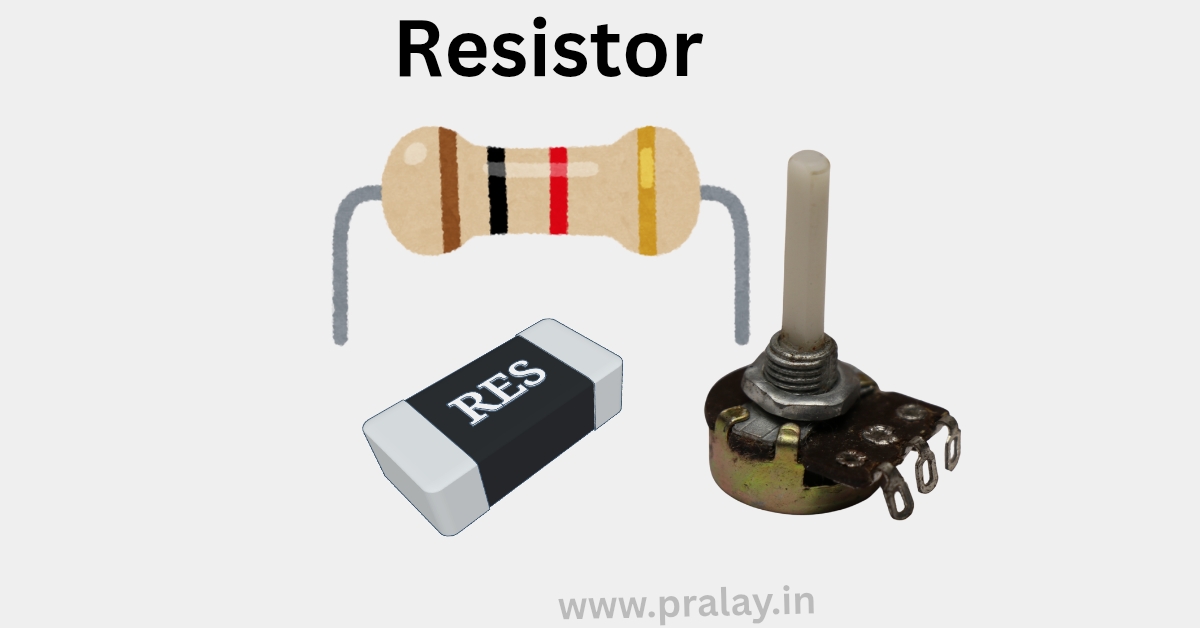
Introduction: A resistor is one of the most fundamental and widely used components in electrical and electronic circuits. As the name suggests, it “resists” the flow of electric current by converting electrical energy into heat. Resistors play a critical role in controlling voltage, current, and signal levels, thereby ensuring safe and efficient circuit operation.
Definition of Resistor
A resistor is a passive two-terminal electronic component that opposes the flow of current, creating a voltage drop across its terminals. The opposition offered by a resistor is known as resistance, measured in ohms (Ω).
The relationship between voltage (V), current (I), and resistance (R) is given by Ohm’s Law:
V=I×R
Symbol of Resistor

In circuit diagrams, resistors are represented using standard symbols:
Related topics


- IEEE Symbol (zigzag line): Common in the United States.
- IEC Symbol (rectangular box): Widely used internationally.
- Textual Symbols: The primary textual symbol for a fixed resistor in schematics is the letter R.
Types of Resistors
Resistors can be broadly categorized based on their construction, behavior, and application:
1. Fixed Resistors
These resistors have a constant resistance value.
- Carbon Composition Resistor – Low cost, general purpose.
- Carbon Film Resistor – Stable and accurate for moderate applications.
- Metal Film Resistor – High accuracy, low noise, better stability.
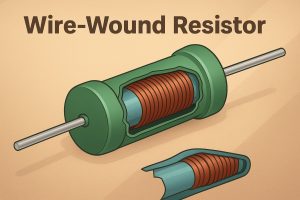
- Wire-Wound Resistor – High power handling, used in power circuits.
2. Variable Resistors
Allow adjustment of resistance manually.
- Potentiometer (POT): Three-terminal device used for voltage division.
- Rheostat: Two-terminal device used for current control.
- Trimmer: Small adjustable resistor used in calibration.
3. Special Resistors
- Thermistors: Temperature-dependent resistors (NTC and PTC).
- Photoresistors (LDRs): Light-sensitive resistors.
- Varistors (VDRs): Voltage-dependent resistors for surge protection.
Resistor Color Code
Resistors are usually marked with colored bands that indicate their resistance value and tolerance. The color code system uses standardized color bands:
- First Band: First digit of resistance.
- Second Band: Second digit.
- Third Band: Multiplier.
- Fourth Band: Tolerance.
| Color | Digit | Multiplier | Tolerance |
|---|---|---|---|
| Black | 0 | ×100 | – |
| Brown | 1 | ×101 | ±1% |
| Red | 2 | ×102 | ±2% |
| Orange | 3 | ×103 | – |
| Yellow | 4 | ×104 | – |
| Green | 5 | ×105 | ±0.5% |
| Blue | 6 | ×106 | ±0.25% |
| Violet | 7 | ×107 | ±0.1% |
| Gray | 8 | ×108 | ±0.05% |
| White | 9 | ×109 | – |
| Gold | – | ×10-1 | ±5% |
| Silver | – | ×10-2 | ±10% |
| None | – | – | ±20% |
Example:
- Brown (1), Black (0), Red (×100), Gold (±5%) → 1,000 Ω (1 kΩ ±5%).
Resistors in Circuits
Resistors are connected in circuits in different configurations to achieve desired voltage and current levels:
Series Connection: Resistance adds up.
\(R_{total} = R_1 + R_2 + R_3 + \dots\)
Parallel Connection: Reciprocal sum of resistance.
\(\frac{1}{R_{total}} = \frac{1}{R_1} + \frac{1}{R_2} + \frac{1}{R_3} + \dots\)
Series-Parallel Networks: Combination of both for complex circuits.
Applications of Resistors
Resistors are indispensable in electrical and electronic applications:
- Voltage Division: Used in potential dividers.
- Current Limiting: Protect LEDs, transistors, and ICs from excess current.
- Biasing: Establish correct operating points in transistors.
- Signal Conditioning: Filtering and shaping signals in communication systems.
- Heat Generation: Employed in heaters and load testing.
- Pull-up and Pull-down: Ensure defined logic levels in digital circuits.
Here’s a FAQ section you can add to the article for better clarity and completeness:
Frequently Asked Questions (FAQ) About Resistors
Q1. What is the function of a resistor in a circuit?
A resistor controls the flow of electric current by providing resistance. It helps regulate voltage, limit current, and protect sensitive components.
Q2. How is resistance measured?
Resistance is measured in ohms (Ω) using an instrument called an ohmmeter or a multimeter.
Q3. What happens if a resistor is not used in a circuit?
Without resistors, excessive current may flow, which can damage electronic components such as LEDs, transistors, or integrated circuits.
Q4. What is the difference between fixed and variable resistors?
- Fixed resistor: Has a constant resistance value that cannot be changed.
- Variable resistor: Allows manual adjustment of resistance to control current or voltage.
Q5. What is tolerance in resistors?
Tolerance indicates the accuracy of the resistor’s value. For example, a 100 Ω resistor with ±5% tolerance may have an actual resistance between 95 Ω and 105 Ω.
Q6. What is the difference between series and parallel resistor connections?
- Series connection: Total resistance increases (sum of all resistors).
- Parallel connection: Total resistance decreases (reciprocal of the sum of reciprocals).
Q7. How do I read the resistor color code?
Each color represents a number. The first two (or three) bands give digits, the next band gives a multiplier, and the last band shows tolerance.
Q8. Can resistors generate heat?
Yes. When current flows through a resistor, electrical energy is converted into heat due to resistance. High-power resistors are specifically designed to dissipate heat safely.
Q9. What is a pull-up or pull-down resistor?
- Pull-up resistor: Connects to the positive supply to ensure a logic “1” when the switch is open.
- Pull-down resistor: Connects to ground to ensure a logic “0” when the switch is open.
Q10. Where are resistors commonly used?
Resistors are used in power supplies, LED circuits, amplifiers, communication systems, computers, and almost every electronic device.
So friends, I’m Pralay Bhunia, I hope I’ve been able to help you with this information about Resistor. If you have any more questions or suggestions, please feel free to share them in the comments. Your support always inspires me to share more new information.
External link:
- EEPower: What Is a Resistor?