Stepper motors have become indispensable components in automation, robotics, CNC systems, and precise motion control applications. Unlike conventional motors that rotate continuously, a stepper motor moves in fixed angular steps, making it exceptionally suited for systems where accuracy, precise positioning, and repeatability are critical. With growing demand for digital manufacturing and robotics, stepper motors have gained significant importance due to their low cost, reliability, and integration with microcontrollers and driver circuits.
From 3D printers and medical equipment to satellite positioning systems and camera stabilization units, stepper motors are found in a wide range of modern technologies. Their compatibility with microcontrollers and easy interfacing through digital signals make them a preferred choice among engineers and hobbyists. This article explains the complete working principle, construction, types, and real-world uses of stepper motors.
What is a Stepper Motor?
A stepper motor is an electromechanical device that converts electrical pulses into precise mechanical movement. It does not rotate continuously like an ordinary motor. Instead, it moves in discrete steps, where each pulse of electrical input generates a specific angular movement. The motor is designed to maintain its position at every step, making it ideal for applications requiring controlled motion without using complex feedback systems.
While servo motors rely on closed-loop control, stepper motors operate on open-loop control, meaning there is no need for feedback unless high-level accuracy is needed. This simplicity allows low-cost implementation in embedded systems, CNC machines, robotics, and positioning applications where predictable angular motion is required.
Working Principle of Stepper Motor
The stepper motor works based on electromagnetism and discrete excitation of winding coils. It consists of a rotor with permanent magnets or soft iron poles and a stator containing multiple windings. When electrical pulses are supplied to the stator coils sequentially, magnetic fields are produced, creating attraction and repulsion forces that move the rotor step by step.
Related topics


The step angle defines how much the rotor moves per pulse and is calculated using the formula:
Step Angle = 360° / (Number of Phases × Number of Poles)
A smaller step angle means higher resolution and accuracy. The direction of rotation can be easily reversed by changing the pulse sequence, and the speed is controlled by changing the pulse frequency. Because the motor locks its position after each step, no external braking is needed for holding torque. This feature makes stepper motors highly efficient in static load conditions and energy-saving applications.
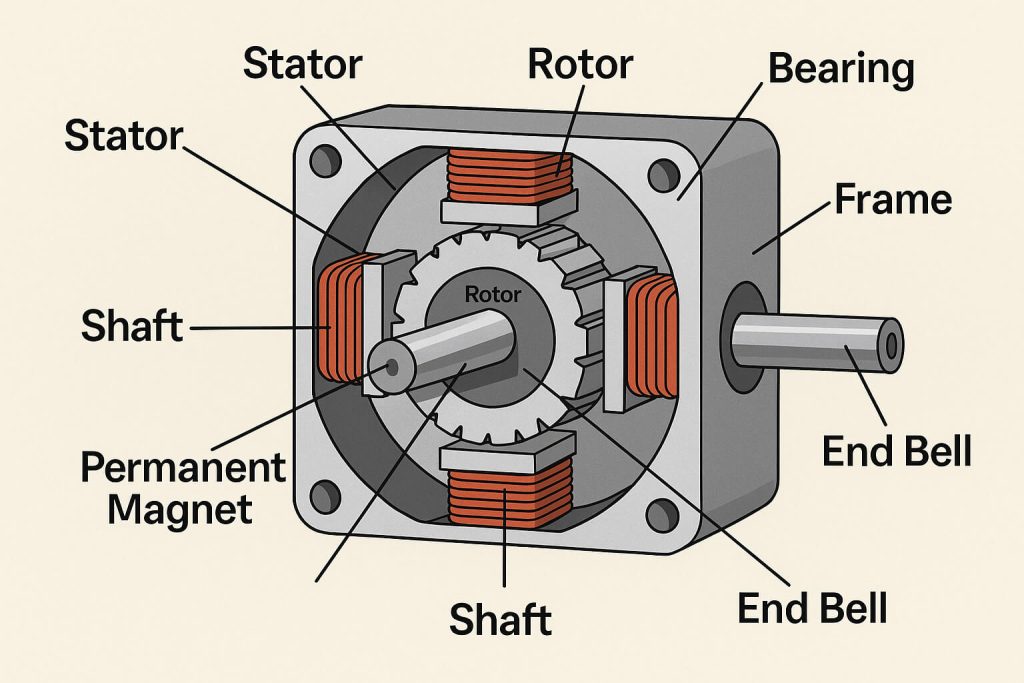
Construction of Stepper Motor
A stepper motor comprises two main parts: the stator and rotor. The stator includes several electromagnetic coils arranged in a circular form. These coils are energized in a specific sequence to create magnetic poles that drive the rotor. The rotor can be either permanent magnet-based, variable reluctance-based, or a hybrid design combining both methods.
The housing of the motor is designed to provide strong mechanical stability and heat dissipation. Bearings support the rotor shaft to ensure smooth motion and reduced friction. Stepper motors use digital input signals from controllers or drivers, which determine the step sequence and timing. High-precision stepper motors use advanced gear systems for torque enhancement and micro-stepping techniques for smoother operation.
Hybrid stepper motors are among the most popular types used today. They offer high torque, fine step resolution, and improved efficiency, making them suitable for automation and high-performance motion control.
Types of Stepper Motors
Stepper motors come in several types depending on rotor design and control method. Permanent Magnet Stepper Motors use magnetic rotors and offer good torque at low speeds. They are common in simple and low-power applications. Variable Reluctance Stepper Motors have soft iron rotors without permanent magnets and rely on magnetic reluctance for rotation. These motors are less common but suitable for fast switching operations.
The most widely used type is the Hybrid Stepper Motor, which combines both permanent magnets and reluctance principles to achieve high precision and torque. Hybrid stepper motors are found in CNC machines, 3D printers, and medical instruments. Due to their ability to provide finer steps and higher accuracy, they are preferred in professional and industrial motion control tasks.
Applications of Stepper Motors
Stepper motors have found widespread use across industries because of their repeatable and precise movement characteristics. In 3D printers, they are responsible for controlling the X, Y, and Z axes. In CNC machines, they guide cutting tools with exact positioning. In robotics, they control joint movement and robotic arm articulation. Scientific instruments, telescopes, and test equipment also rely on stepper motors for alignment and fine adjustment.
In the medical field, stepper motors are used in drug dispensing systems, dialysis machines, and laboratory automation. Camera gimbals and stabilizers use stepper motors to provide smooth motion. Automotive dashboards, textile machines, ATM systems, and plotters are further examples of real-world stepper motor applications.
One of the major advantages of stepper motors is their ability to hold a position under load without power-intensive braking systems. This makes them energy-efficient and reliable for static load conditions. Additionally, stepper motors are easy to interface with microcontrollers such as Arduino, ESP32, and Raspberry Pi, which explains their popularity in embedded electronics education and prototype development.
Control of Stepper Motor
Stepper motors are controlled by sending digital pulses to the driver circuit, which energizes the coils in the correct sequence. The pulse frequency determines the speed, while the pulse count defines the angle of rotation. Full-step, half-step, and micro-stepping modes determine the movement resolution and smoothness.
The most commonly used driver ICs include A4988, DRV8825, and TMC series chips, allowing high-precision control via PWM signals. Advanced stepper controllers incorporate current limiting, thermal protection, and acceleration profiles to enhance performance and protect the motor from overload or overheating.
Advantages of Stepper Motors
Stepper motors offer many technical benefits. They do not require feedback for basic operation and can maintain their position without slipping under moderate loads. They provide excellent low-speed torque, reliable step accuracy, and easy digital interfacing. Stepper motors are ideal for open-loop systems where precision and affordability are more important than dynamic response.
Although they may lose steps at higher speeds or heavy loads, hybrid stepper models and micro-stepping techniques provide enhanced performance. Their maintenance-free nature and compatibility with programmable control systems make them a preferred choice in automation and motion control.
Future Trends in Stepper Motor Technology
The future of stepper motors is shaped by robotics, smart manufacturing, and high-precision digital systems. With evolving technologies such as Industry 4.0 and IoT-based automation, stepper motors are being integrated with advanced control modules and communication interfaces. Hybrid stepper motors combined with feedback sensors are being developed to bridge the gap between servo and stepper technologies.
Energy-efficient motors with high torque density are gaining popularity in electric mobility, medical devices, aerospace, and micro-fabrication industries. Research continues on noise reduction, controlled acceleration, and intelligent positioning using AI-based algorithms.
Stepper motors are expected to remain valuable due to their simplicity, reliability, and compatibility with digital technology. Their role in precision motion will continue to grow as automation and robotics expand in modern engineering.
Stepper Motor vs Servo Motor
A stepper motor operates using an open-loop control system and moves in fixed angular steps. It is designed for applications that require predictable motion without the need for feedback. Stepper motors are easy to control using digital pulses and hold their position effectively at each step, making them ideal for 3D printers, CNC machines, camera sliders, and basic robotic mechanisms. However, they may lose steps under heavy loads and are generally less efficient at higher speeds.
A servo motor, on the other hand, works on a closed-loop control system with real-time feedback from sensors such as encoders. This allows the motor to correct positional errors instantly, ensuring high precision and smooth motion. Servo motors provide high torque at various speeds and are capable of rapid acceleration and deceleration. They are widely used in robotic arms, industrial automation, aerospace systems, and high-performance machinery that require precise motion control.
In summary, stepper motors offer simplicity and cost-effectiveness for moderate precision tasks, whereas servo motors deliver superior accuracy, power, and dynamic control for advanced industrial and automation applications. The choice depends on the required torque, precision level, cost constraints, and control system complexity.
Comparison Table
| Parameter | Stepper Motor | Servo Motor |
|---|---|---|
| Control System | Open-loop | Closed-loop (feedback-based) |
| Motion Type | Step-by-step movement | Smooth continuous motion |
| Accuracy | Moderate | Very high |
| Feedback Required | Not required | Always required |
| Torque at Low Speed | High | High |
| Torque at High Speed | Drops significantly | Remains strong |
| Position Holding | Good without feedback | Excellent with feedback |
| Cost | Low | Higher |
| Best For | CNC, 3D printers, hobby robots | Industrial automation, robotics, CNC |
| Speed | Limited | Very high |
| Efficiency | Moderate | High |
| Maintenance | Almost none | Slightly more |
| Response Time | Slow to moderate | Very fast |
| Control Method | Pulse signal sequence | PWM + encoder feedback |
| Application Level | Medium precision | High precision and performance |
Frequently Asked Questions (FAQ)
1. What is a stepper motor?
A stepper motor is an electromechanical device that rotates in precise steps rather than continuous motion.
2. How does a stepper motor work?
It works by energizing coils in sequence, causing the rotor to move step by step based on pulse inputs.
3. Is a stepper motor an AC or DC motor?
It is a DC motor type but controlled using digital pulses and driver circuits.
4. What is the advantage of using a stepper motor?
It offers accurate positioning without needing feedback in basic systems.
5. What is step angle?
Step angle is the amount of rotation a motor makes per electrical pulse, usually measured in degrees.
6. What is holding torque in a stepper motor?
It is the torque needed to move the rotor when it is energized but not rotating.
7. What is the difference between stepper and servo motors?
A stepper motor works open-loop, while a servo motor uses feedback for higher accuracy and control.
8. Can a stepper motor skip steps?
Yes, if overloaded or driven at high speed without proper control.
9. Where are stepper motors used?
They are used in 3D printers, CNC machines, medical devices, robotics, and camera systems.
10. Do stepper motors require feedback sensors?
Not always, but feedback can be added for enhanced precision in hybrid systems.
11. What is micro-stepping in stepper motors?
It is a control method that divides each step into smaller movements for smoother rotation.
12. Can stepper motors run at high speed?
They can, but torque decreases at higher speeds compared to servo motors.
13. What is a hybrid stepper motor?
It combines permanent magnet and variable reluctance features for better performance and accuracy.
14. Do stepper motors need a driver?
Yes, a motor driver controls the pulse sequence and current supply to the coils.
15. Are stepper motors cost-efficient?
Yes, they are affordable and widely used in automated and embedded systems.
So friends, I’m Pralay Bhunia, I hope I’ve been able to help you with this information about Stepper Motor. If you have any more questions or suggestions, please feel free to share them in the comments. Your support always inspires me to share more new information.