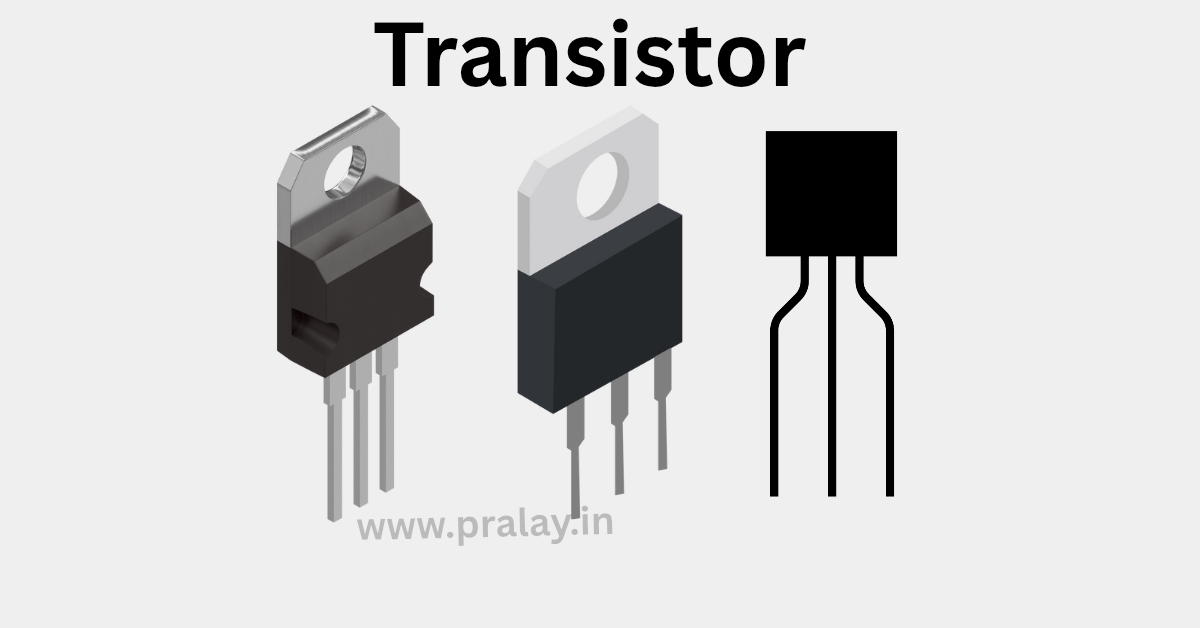
The transistor is one of the most revolutionary inventions in electronics and communication engineering. It forms the foundation of modern electronic devices, from tiny microprocessors in smartphones to powerful circuits in industrial equipment. Understanding the transistor is essential for anyone who wishes to explore the world of electronics deeply.
Introduction to Transistor
A transistor is a semiconductor device used to amplify or switch electronic signals and electrical power. Introduced in 1947 at Bell Laboratories, it replaced bulky vacuum tubes and paved the way for compact, efficient, and reliable electronic circuits. Today, billions of transistors are fabricated on a single microchip, powering advanced digital systems.
Definition of Transistor
A transistor can be defined as a three-terminal semiconductor device that regulates current or voltage flow and acts as a switch or amplifier. It is made from semiconductor materials like silicon or germanium and is designed to control the movement of charge carriers (electrons or holes).
Transistor Definition and Working | Basics of Modern Electronics
A transistor is a semiconductor device used to amplify or switch electronic signals and electrical power. It is the fundamental building block of modern electronic devices, serving as the foundation for everything from radios and computers to smartphones and satellites. Since its invention in 1947 at Bell Laboratories by John Bardeen, Walter Brattain, and William Shockley, the transistor has revolutionized technology, enabling the creation of compact, energy-efficient, and highly reliable electronic systems.
At its core, a transistor regulates the flow of electric current through semiconductor materials, typically silicon or germanium. It operates by using a small input signal to control a much larger current, acting as a gate between circuits. This property allows transistors to perform logical operations in digital circuits or amplify weak signals in analog devices. According to Moore’s Law, the number of transistors on an integrated circuit doubles roughly every two years, illustrating the pace of innovation and miniaturization in semiconductor technology.
Related topics
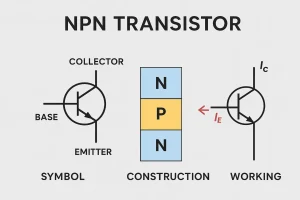


Structurally, a transistor is composed of three regions known as the emitter, base, and collector in a bipolar junction transistor (BJT), or as source, gate, and drain in a field-effect transistor (FET). The interplay between these regions determines how current is allowed or blocked. For instance, in an NPN transistor, when a small current enters the base, it allows a larger current to flow from the collector to the emitter — a principle that makes it invaluable for amplification.
Transistors are generally classified into two major types: bipolar junction transistors (BJTs) and field-effect transistors (FETs). BJTs use both electrons and holes as charge carriers, making them suitable for high-gain amplification applications. FETs, on the other hand, rely solely on either electrons or holes and are commonly used in integrated circuits due to their high efficiency and low power consumption. The Metal-Oxide-Semiconductor Field-Effect Transistor (MOSFET), a subtype of FET, dominates modern electronics, especially in computer processors and memory chips.
The impact of the transistor on technology and society cannot be overstated. It paved the way for the digital revolution, replacing bulky vacuum tubes and enabling the miniaturization of circuits that power today’s electronic devices. As physicist Richard Feynman once remarked, “There’s plenty of room at the bottom,” highlighting the potential of micro and nano-scale technologies — a vision realized through transistor innovation.
In today’s digital age, transistors continue to evolve, becoming smaller, faster, and more energy-efficient. Researchers are exploring advanced materials like graphene and gallium nitride to push beyond the limits of silicon. With over trillions of transistors packed into modern microprocessors, this tiny component remains the silent powerhouse driving innovation, computation, and communication across the globe.
Types of Transistors
Transistors can broadly be classified into two main categories:
- Bipolar Junction Transistor (BJT): Operates with current control and consists of three regions – emitter, base, and collector. It is further divided into NPN and PNP types.
- Field Effect Transistor (FET): Works with voltage control and consists of three terminals – source, gate, and drain. Variants include JFET (Junction Field Effect Transistor) and MOSFET (Metal Oxide Semiconductor FET).
Each type has its specific application. BJTs are widely used in amplification, while MOSFETs dominate in digital circuits and power electronics due to their high efficiency.
Working Principle of a Transistor
The working of a transistor depends on controlling the flow of current between two terminals with the help of a third terminal. In a BJT, a small input current at the base controls a larger current between the emitter and collector. In a FET, the gate voltage controls the current flowing between the source and drain. This principle enables the transistor to function as an amplifier and as an electronic switch.
Symbol of Transistor

Transistor symbols are standardized in circuit diagrams for easy identification. An NPN transistor symbol shows the arrow pointing out of the emitter, while a PNP transistor symbol shows the arrow pointing inward. For FETs, the symbols vary depending on whether it is a JFET or MOSFET, with clear indications for source, drain, and gate terminals.
Function of Transistor
The primary functions of a transistor include:
- Amplification of weak electrical signals in radios, microphones, and audio devices.
- Switching operations in digital logic circuits and microprocessors.
- Regulation of current in power supplies and voltage stabilizers.
- Signal modulation in communication systems.
Transistor Biasing
For proper operation, a transistor must be biased correctly. Biasing means applying suitable DC voltages to the transistor terminals so that it works in the desired region. The major biasing methods include fixed bias, voltage divider bias, and emitter bias. Proper biasing ensures stability and reliable performance of the circuit.
Transistor Circuit
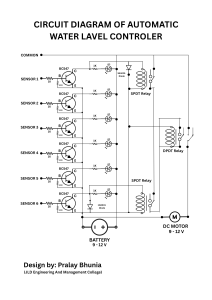
A transistor circuit refers to an arrangement where transistors are connected with resistors, capacitors, or other components to perform specific tasks. Examples include common-emitter amplifier circuits for signal boosting, transistor switch circuits for controlling loads, and oscillator circuits for generating periodic signals. These circuits form the basis of modern electronics, from simple LED drivers to complex integrated circuits.
Frequently Asked Questions (FAQ)
Q1: What is a transistor in simple words?
A transistor is a small electronic device made of semiconductor material that can amplify signals or act as a switch in circuits.
Q2: What are the main types of transistors?
The two main types are Bipolar Junction Transistor (BJT) and Field Effect Transistor (FET), including subtypes like NPN, PNP, JFET, and MOSFET.
Q3: What is the main function of a transistor?
Its primary functions are amplification of weak signals and switching electrical currents in digital and analog circuits.
Q4: How does a transistor work as an amplifier?
In amplifier mode, a small input current or voltage at one terminal controls a larger current between two other terminals, boosting the signal strength.
Q5: What is transistor biasing and why is it important?
Biasing means applying the right DC voltages to a transistor’s terminals. It ensures stable operation, prevents distortion, and sets the transistor in the desired region.
Q6: Where are transistors used in daily life?
They are used in smartphones, computers, radios, televisions, audio systems, power supplies, and all modern electronic devices.
Q7: What is the symbol of a transistor?
The symbol varies by type. In NPN transistors, the emitter arrow points outward, while in PNP transistors, it points inward. FET symbols show gate, source, and drain.
Q8: Who invented the transistor?
The transistor was invented in 1947 at Bell Laboratories by John Bardeen, William Shockley, and Walter Brattain.
So friends, I’m Pralay Bhunia, I hope I’ve been able to help you with this information about Transistor. If you have any more questions or suggestions, please feel free to share them in the comments. Your support always inspires me to share more new information.
External link
- ScienceDirect: Transistor – an overview