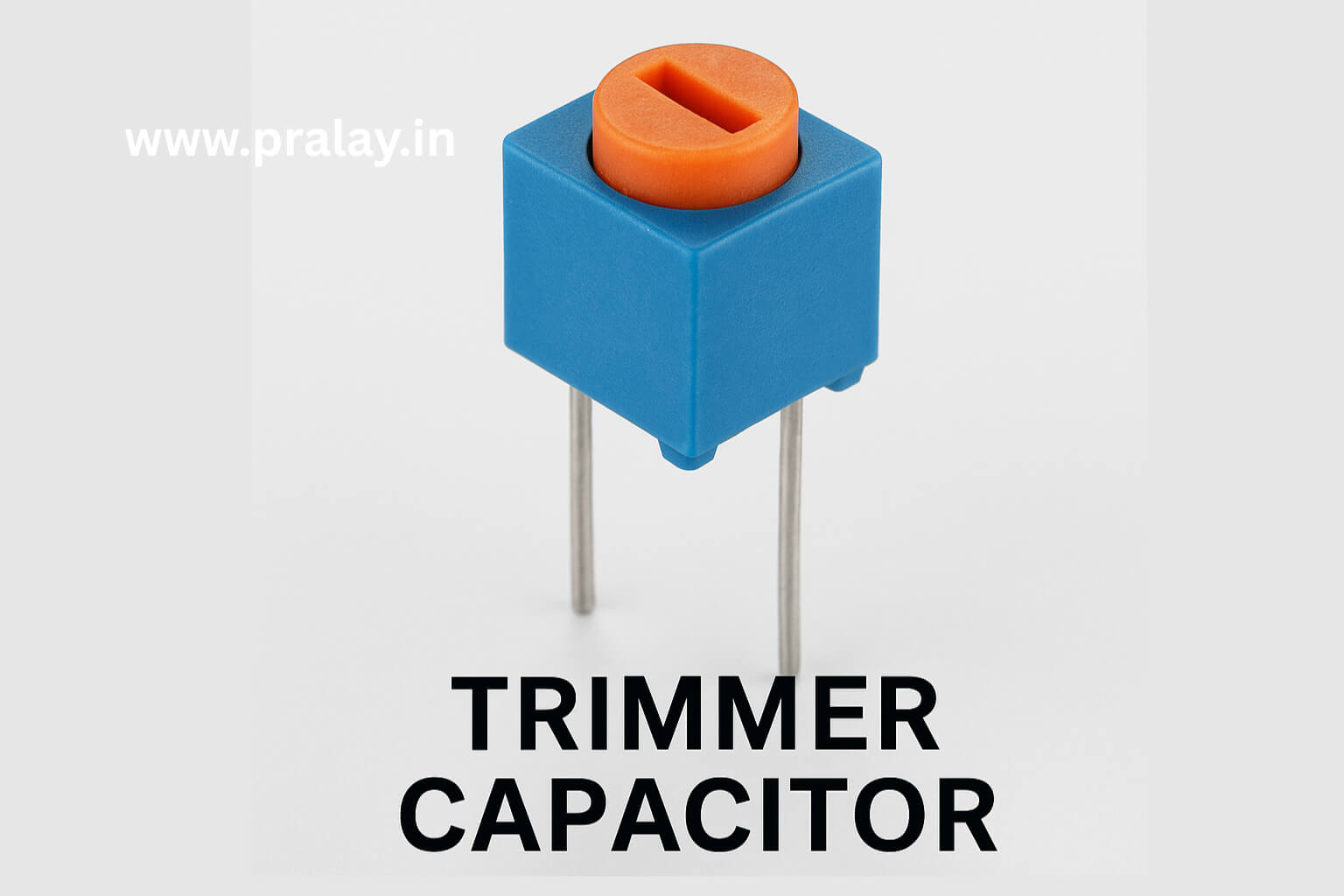
In high-frequency and precision electronic circuits, accurate tuning is essential. A trimmer capacitor, also known as a variable capacitor, provides small adjustments to capacitance for calibration and fine-tuning purposes. These capacitors are frequently found in radio receivers, oscillators, antenna matching networks, RF filters and communication circuits where stable frequency control is important. Despite their small size, trimmer capacitors play a vital role in optimizing performance and ensuring signal accuracy.
As electronic devices become more compact and digitally controlled, the use of trimmer capacitors remains common in radio-frequency (RF) technology, testing instruments and high-end embedded systems.
What is a Trimmer Capacitor?
A trimmer capacitor is a small adjustable capacitor designed to fine-tune the capacitance in a circuit. It is not used for continuous adjustment like a tuning capacitor but rather for calibration and setting the circuit to a fixed value during manufacturing or servicing. Once adjusted, the capacitor is typically left untouched. This makes it essential in applications where precise control of oscillation frequency, impedance or phase is required.
Trimmer capacitors generally have a limited capacitance range, typically between 5 pF and 100 pF, depending on the design. They are compact, lightweight and available in PCB-mountable packages suitable for both SMT and THT assembly.
Working Principle of Trimmer Capacitor
The trimmer capacitor works by controlling the overlapping area or distance between its plates. When the adjustment screw is turned, it changes the geometry of the capacitor, modifying its capacitance value. Just like fixed capacitors, it operates based on the formula:
Related topics


C = εA / d
Where:
• C = Capacitance
• A = Effective overlapping area
• d = Distance between plates
• ε = Dielectric constant
Trimmer capacitors are usually adjusted with a small screwdriver and require minimal torque. Once set, they hold their value and help stabilize the overall circuit performance, especially in RF, IF and VHF ranges.
Construction of Trimmer Capacitor
A trimmer capacitor typically consists of two plates—a fixed plate and a movable plate. These plates are separated by a dielectric material such as air, ceramic or plastic. The movable part is connected to an adjustment screw. As the screw rotates, the distance or overlapping area between the plates changes, which alters the capacitance.
The body is usually made of plastic, ceramic or metal, depending on the application. SMD versions are often used in compact PCBs, while THT trimmer capacitors are preferred in manual tuning and radio repair circuits. Metal shielding may also be added to prevent electromagnetic interference, especially in RF communication systems.
Types of Trimmer Capacitors
Trimmer capacitors can be classified based on their dielectric materials and construction styles. Ceramic trimmer capacitors are very common and suitable for general RF tuning applications. Air dielectric trimmers offer excellent linearity and low loss, making them suitable for high-frequency communication circuits. Plastic foil trimmers are compact and affordable, used in low-cost tuning applications.
Modern electronics also utilize SMD trimmer capacitors, which are surface-mounted on PCBs and used in automatic test equipment, portable devices and communication modules. These provide high stability and are compatible with mass production.
Importance in RF and Calibration Circuits
The role of trimmer capacitors becomes crucial when precise tuning is required in high-frequency circuits. In radio receivers, trimmer capacitors ensure that a specific frequency is selected accurately. In oscillator circuits, they help maintain the correct output frequency despite temperature variations and component tolerances. In LC tank circuits, trimmer capacitors are paired with inductors to refine resonance frequency.
These capacitors are also used in antenna matching, impedance control, elimination of frequency drift and selective filtering. In manufacturing and service operations, trimmer capacitors are the final step in ensuring circuit accuracy.
Applications of Trimmer Capacitors
Trimmer capacitors have a wide range of uses across radio, communication and measurement industries. They are found in RF transmitters and receivers, frequency modulators, tunable filters, PLL (Phase-Locked Loop) circuits and VCOs (Voltage-Controlled Oscillators). Antenna tuning units, satellite receivers, signal boosters and TV tuners also rely on trimmer capacitors for optimal signal reception.
In testing equipment and laboratory instruments, trimmer capacitors are used for calibration settings. In consumer electronics, they enable precise tuning in TV tuners, Bluetooth modules, Wi-Fi boards and wireless audio systems. Their high-frequency performance and reliability make them indispensable in RF circuit design.
Advantages of Trimmer Capacitors
Trimmer capacitors provide precision calibration, compact size and stable performance. They require little maintenance and allow for easy adjustment even after assembly. Due to their small footprint, they can be integrated into miniature circuits and surface-mount PCBs. Their ability to correct component variations makes them highly valuable during manufacturing and field servicing. Additionally, they support high-frequency applications where fixed capacitors alone cannot guarantee accuracy.
Limitations of Trimmer Capacitors
The main drawback of trimmer capacitors is limited adjustment range. They are not ideal for continuous tuning applications like conventional tuning capacitors. They may also suffer from vibration sensitivity and require careful adjustment to avoid damage. Over-tightening the adjustment screw may lead to mechanical wear or change in capacitance over time.
Electronic alternatives such as varactor diodes are increasingly used in precision RF tuning, offering voltage-controlled capacitance without mechanical adjustment. However, trimmer capacitors remain valuable in analog, educational and service-oriented applications.
Future Trends in Trimmer Capacitor Technology
The rise of smart communication systems and IoT-based RF devices has increased demand for compact tuning solutions. Researchers are developing MEMS-based variable capacitors and digital trimmer designs that can be controlled via microcontrollers. These technologies will improve tuning accuracy and reduce mechanical reliability issues.
However, trimmer capacitors are expected to continue playing a key role in RF prototyping, military radios, amateur communication and low-power analog circuits. As long as calibration is required, trimmer capacitors will hold their place in electronic engineering.
Trimmer Capacitor vs Tuning Capacitor
Both trimmer capacitors and tuning capacitors belong to the family of variable capacitors, but they serve different purposes in electronic circuits. A tuning capacitor is designed for frequent manual adjustment and is typically used in radio receivers and LC circuits to change frequency continuously. It can be rotated easily through a knob and is often used by the end user to select stations or adjust resonance.
A trimmer capacitor, on the other hand, is meant for calibration or fine adjustment during manufacturing or servicing. Once the capacitance is set, it typically remains fixed. It is smaller in size and usually adjusted using a small screwdriver. Trimmer capacitors are used inside circuits and are not meant for dynamic tuning by the user.
Tuning capacitors have a wider capacitance range and allow continuous adjustment, while trimmer capacitors have a limited adjustment range, generally between 5 pF and 100 pF. In RF communication, tuning capacitors are used for primary frequency control, whereas trimmer capacitors are used for precision alignment and compensation.
In summary, tuning capacitors are preferred for user-adjustable tuning, while trimmer capacitors are ideal for fine calibration and circuit stability. Both remain highly important in LC circuits, oscillators, RF designs and antenna matching networks.
Comparison Table
| Parameter | Trimmer Capacitor | Tuning Capacitor |
|---|---|---|
| Purpose | Fine adjustment & calibration | Continuous frequency tuning |
| Adjustment Frequency | Set once and left fixed | Adjusted regularly by the user |
| Capacitance Range | Typically 5 pF – 100 pF | Wider range, up to 500 pF or more |
| Operation Method | Adjusted with a screwdriver | Adjusted with a knob or dial |
| Size | Very small and compact | Larger in size |
| Mounting Type | Mostly PCB-mounted (SMD/THT) | Panel or chassis-mounted |
| Frequency Usage | Precision RF alignment | Frequency tuning in radios & LC circuits |
| Mechanical Complexity | Simple | More complex moving parts |
| User Interaction | Adjusted only during calibration | Accessible to end user |
| Stability | High after setting | More susceptible to drift |
| Typical Applications | RF calibration, PLL, VCO, test equipment | Radio receivers, oscillators, antenna tuning |
| Dielectric Types | Ceramic, air, plastic | Mostly air or mica dielectric |
| Cost | Relatively low | Moderate to high |
| Tuning Method | Screw-based adjustment | Rotor-stator plate rotation |
| Modern Alternative | Varactor diode | Digital tuning capacitor or DDS |
Frequently Asked Questions (FAQ)
1. What is a trimmer capacitor?
A trimmer capacitor is a small adjustable capacitor used for fine-tuning and calibration in electronic circuits.
2. What is the purpose of a trimmer capacitor?
It is used to adjust the capacitance to achieve precise frequency control during circuit calibration.
3. Where are trimmer capacitors used?
They are commonly used in RF circuits, oscillators, filters, radio tuners, PLLs, and antenna matching networks.
4. Are trimmer capacitors polarized?
No, trimmer capacitors are non-polarized and can be connected in any orientation.
5. What is the typical capacitance range?
They usually range from 5 pF to 100 pF, depending on design and application.
6. What is the difference between a tuning capacitor and a trimmer capacitor?
A tuning capacitor is meant for frequent adjustments, while a trimmer capacitor is used for one-time calibration.
7. How do you adjust a trimmer capacitor?
It is adjusted using a small screwdriver to rotate the movable plate or screw mechanism.
8. Can trimmer capacitors be used in digital circuits?
Yes, they are used in RF modules and wireless communication systems for precise calibration.
9. What type of dielectric materials are used?
Common materials include ceramic, air, plastic film, or mica.
10. What causes a trimmer capacitor to lose accuracy?
Excessive torque, mechanical wear, vibrations, and temperature changes may affect stability.
11. Is it suitable for high-frequency circuits?
Yes, especially in RF, VHF, and UHF applications where fine tuning is required.
12. What tool is needed to adjust it?
A plastic or non-metallic screwdriver is recommended to avoid circuit interference.
13. Can trimmer capacitors be surface mounted?
Yes, SMD variants are commonly used in compact electronic devices.
14. What is an alternative to trimmer capacitors?
Varactor diodes and digitally controlled capacitors are used as electronic tuning alternatives.
15. Are trimmer capacitors still used today?
Yes, they remain essential in RF circuits, antenna tuning, laboratory instruments, and calibration equipment.
So friends, I’m Pralay Bhunia, I hope I’ve been able to help you with this information about trimmer capacitors. If you have any more questions or suggestions, please feel free to share them in the comments. Your support always inspires me to share more new information.
Externall links: